Choosing an IGBT module for an industrial motor drive is not only a voltage and current exercise. The right module must fit the DC bus, motor load, switching pattern, thermal design, package footprint, gate driver, protection circuit, and sourcing risk of the equipment.
For procurement teams, the practical question is simple: which details must be confirmed before requesting a quote? For engineers, the question is more technical: which datasheet limits decide whether the module can survive the real operating conditions?
This guide explains the selection process from both sides. It is written for buyers, engineers, OEM/EMS teams, and repair teams that need to source IGBT modules for inverters, servo drives, pumps, fans, compressors, and other industrial motor-drive systems.
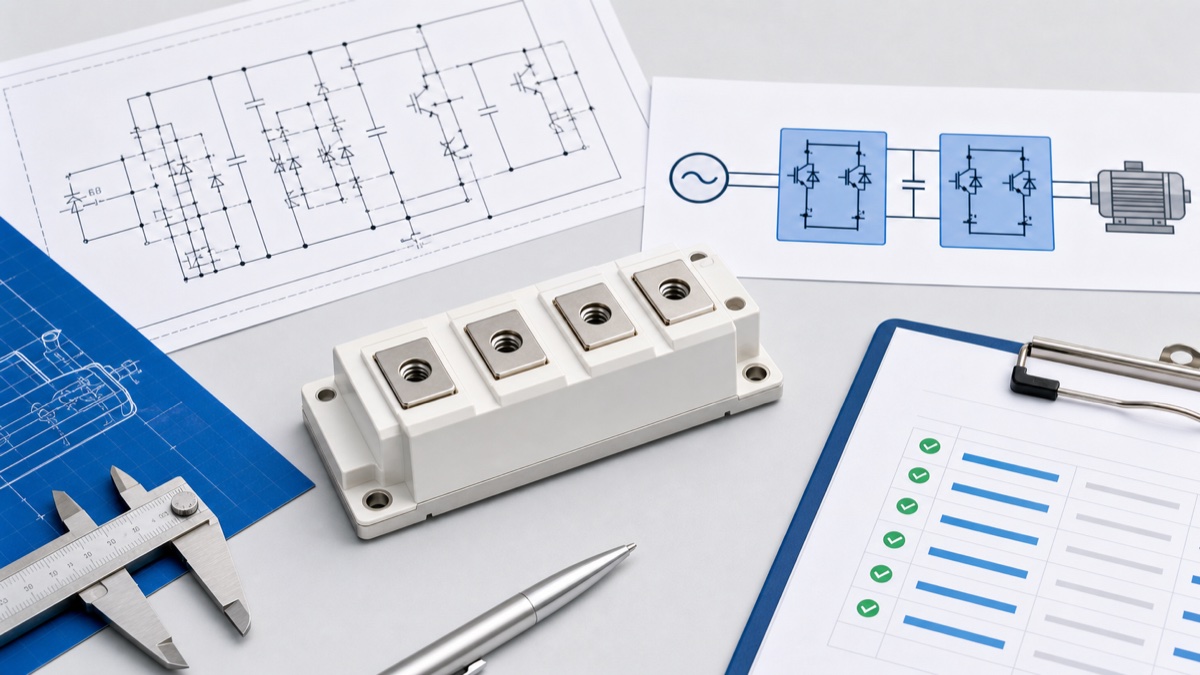
Quick Answer
To choose an IGBT module for an industrial motor drive, start with the drive's DC bus voltage, output current, motor power, overload profile, switching frequency, cooling method, package size, and gate-driver requirements. Then compare candidate modules by voltage rating, current rating, thermal resistance, loss data, short-circuit rating, insulation rating, package footprint, lifecycle status, and documentation availability.
For sourcing, the RFQ should include the manufacturer, full part number, quantity, package, voltage and current requirements, application type, target date, and any inspection or documentation needs. Availability, pricing, and lead time should be confirmed through RFQ.
| Selection area | What to confirm | Why it matters |
|---|
| Voltage rating | DC bus voltage, transient margin, insulation requirement | Reduces overvoltage and safety risk |
| Current rating | RMS current, peak current, overload time, duty cycle | Prevents undersizing under real load |
| Thermal design | Case temperature, heatsink, airflow or liquid cooling | Determines whether losses can be removed |
| Package fit | Footprint, terminals, mounting, isolation | Avoids mechanical and layout mismatch |
| Gate drive | Gate voltage, resistor range, protection behavior | Affects switching loss and fault response |
| Sourcing risk | Lifecycle, date code, documentation, inspection needs | Helps avoid obsolete, mismatched, or high-risk supply |
Start With the Motor Drive Requirements
Do not begin with a familiar part number unless the design is already fixed. Begin with the drive requirements, then match the module to the electrical, thermal, and mechanical design.
For a new design or replacement review, collect these inputs first:
AC input voltage and expected DC bus voltage
Motor power, rated current, peak current, and overload profile
Switching frequency and modulation method
Ambient temperature and maximum case temperature target
Cooling method, including heatsink, forced air, or liquid cooling
Available package size, mounting holes, terminals, and busbar layout
Gate-driver voltage, isolation, desaturation or short-circuit protection
Safety, insulation, documentation, and inspection requirements
The primary keyword here is not just "IGBT module." The buyer's real search intent is usually "which IGBT module can fit my motor-drive requirement without creating thermal, compatibility, or sourcing risk?"
If the module is for repair or replacement, the original part number is still important. Buyers should verify the manufacturer, full part number, module series, package, terminal layout, voltage and current rating, and datasheet revision before treating any alternative as a fit.
Check Voltage, Current, and Thermal Margin
The three most visible ratings are voltage, current, and temperature. They are also the easiest to misuse if they are read without the operating conditions.
Voltage Rating
Choose a module voltage class that can handle the DC bus and expected transients. Common industrial motor-drive designs often compare module classes such as 600 V, 650 V, 1200 V, and 1700 V, but the correct rating depends on the actual bus voltage, surge conditions, insulation requirements, and protection design. Each design should be checked against the exact module datasheet.
The datasheet should be checked for collector-emitter voltage, isolation voltage, creepage and clearance information where provided, and any manufacturer application guidance.
Current Rating
The current rating must be compared against the drive's real load profile, not only the motor nameplate. Review continuous RMS current, peak current, overload duration, carrier frequency, heatsink condition, and case temperature.
For high-overload applications such as servo axes, hoists, compressors, and heavy-start pumps, the short-term current profile can decide the module size. A module that looks adequate at one temperature may be unsuitable at a higher case temperature.
Thermal Margin
Thermal design is where many IGBT module choices fail. Review conduction loss, switching loss, junction temperature limit, case temperature, thermal resistance, thermal interface material, and heatsink performance.
The practical question is: can the design remove heat under the worst expected operating condition? If the answer is unclear, the buyer should ask the engineering team for loss calculations, thermal simulation, or manufacturer application guidance before purchasing.
For background reading on power semiconductor module behavior and application considerations, buyers can review the SEMIKRON-Danfoss application manual for power semiconductors. Use manufacturer documentation as technical context, not as a substitute for checking the exact module datasheet.
Compare Package, Gate Drive, and Cooling Fit
An IGBT module can match voltage and current on paper and still fail the project because the package, gate drive, or cooling interface does not fit.
Package and Mechanical Fit
Check the package outline, terminal style, screw positions, baseplate, insulation structure, and mounting torque guidance. For replacement sourcing, compare the original module and candidate module side by side against datasheets. Small mechanical differences can affect busbar layout, heatsink contact, assembly time, and serviceability.
Gate-Driver Requirements
Gate-drive compatibility should be reviewed before substitution. Confirm gate voltage, recommended gate resistance, switching behavior, short-circuit withstand time, desaturation protection, Miller clamp needs, and any negative gate bias requirements.
Procurement teams do not need to calculate every gate-drive parameter, but they should know when to involve engineering. If the gate-drive details are unknown, avoid treating two modules as interchangeable only because their voltage and current ratings match.
Cooling and Mounting
Cooling fit includes more than the heatsink size. Review thermal grease or pad requirements, flatness, mounting torque, airflow path, fan redundancy, and allowable case temperature. For high-power drives, inconsistent mounting pressure or poor thermal interface material can erase the margin assumed in the datasheet review.
Review Quality, Lifecycle, and Sourcing Risk
IGBT modules are high-value power components, so sourcing risk matters. Before purchase, buyers should confirm lifecycle status, documentation availability, date code expectations, packaging condition, and any quality-control needs.
NTCHIP's role as an independent electronic components sourcing partner is to help buyers review sourcing options and RFQ details. This does not replace engineering approval, manufacturer documentation, or application testing.
For quality-sensitive orders, ask about:
Full manufacturer part number and module series
Package condition and handling requirements
Date code expectations
Datasheet revision used for review
Photos or documentation available before shipment
Inspection requirements for high-risk or obsolete supply
Whether the order is for production, repair, sample validation, or urgent MRO support
If a module is obsolete, scarce, or sourced outside normal authorized channels, the review should be stricter. The buyer should document acceptable alternates, reject conditions, and inspection requirements before issuing the purchase order.
For broader quality-control context, NTCHIP buyers can review the quality support page and discuss inspection needs during RFQ.
Prepare an IGBT Module RFQ
A clear RFQ reduces back-and-forth and helps the sourcing team avoid unsafe assumptions. Send the exact part number when available, but also include the application context when the module is for a motor drive.
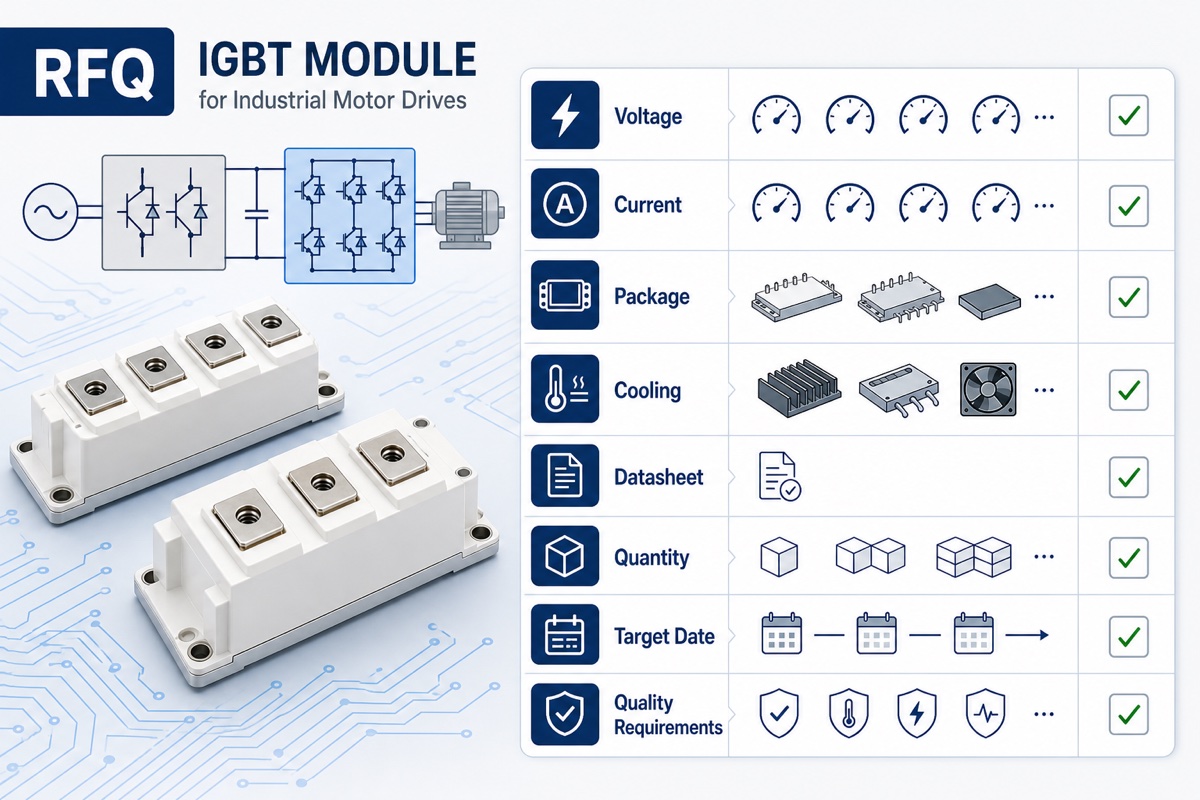
| RFQ field | What to provide |
|---|
| Manufacturer and full part number | Include suffixes, package codes, and module series when known |
| Quantity | Separate sample, repair, and production quantities |
| Voltage and current requirement | Provide DC bus voltage, output current, and overload notes when available |
| Package requirement | Include photos, datasheet, or original module details for replacement sourcing |
| Target date | State required delivery timing, but confirm lead time through RFQ |
| Application | Inverter, servo drive, pump, fan, compressor, UPS, or other equipment type |
| Quality requirements | Documentation, photos, date code request, or inspection needs |
| Alternate policy | State whether alternates are allowed and who must approve them |
You can send the part number, quantity, target date, and application notes through the NTCHIP RFQ page. For BOM-level sourcing, the products page can help buyers identify related categories before requesting a quote.
Common Selection Mistakes
The most common mistake is choosing by current rating alone. Current ratings depend on case temperature, cooling condition, switching frequency, and duty cycle. A higher printed current rating does not automatically mean a safer module in a real drive.
Other mistakes include:
Ignoring transient voltage margin and protection design
Treating different packages as drop-in replacements without checking the outline
Overlooking gate-driver differences during substitution
Using old datasheets without checking lifecycle or revision status
Assuming availability, price, or lead time without RFQ confirmation
Skipping inspection requirements for scarce, obsolete, or high-value modules
Selecting an alternate before engineering confirms electrical and thermal fit
For replacement projects, the safest approach is to treat the original module as a reference, not as the only data point. Compare the original module, candidate replacement, datasheets, package drawings, and application requirements before approving a sourcing path.
FAQ
What information is most important when choosing an IGBT module for a motor drive?
The most important information is the DC bus voltage, output current, overload profile, switching frequency, cooling design, package footprint, gate-driver requirements, and application environment. For purchasing, the full manufacturer part number and quantity are also essential.
Can I replace an IGBT module with another module that has the same voltage and current rating?
Not without datasheet verification. Voltage and current are only part of the decision. Package, terminal layout, thermal resistance, gate-drive behavior, short-circuit rating, insulation, and lifecycle status also need review.
What voltage class should I choose for an industrial motor drive?
The voltage class depends on the DC bus voltage, input supply, transients, insulation needs, and protection design. Common module classes include 600 V, 650 V, 1200 V, and 1700 V, but the correct choice needs datasheet and application verification.
Why does thermal resistance matter in IGBT module selection?
Thermal resistance affects how heat moves from the junction to the case and heatsink. If the module cannot remove heat fast enough, junction temperature can exceed safe limits even when the current rating looks acceptable.
What should I include in an IGBT module RFQ?
Include manufacturer, full part number, quantity, target date, voltage/current requirements, package needs, application type, acceptable alternates, and quality or documentation requirements. Availability, pricing, and lead time should be confirmed through RFQ.
Conclusion
An IGBT module for an industrial motor drive should be selected around the real operating conditions, not a single datasheet line. The best RFQ starts with the drive voltage, current, overload profile, cooling design, package constraints, gate-driver requirements, and sourcing risk.
If you need to source an exact IGBT module or review possible alternates, send NTCHIP the full part number, quantity, target date, application notes, and quality requirements. NTCHIP can help review sourcing options, while engineering teams should confirm final electrical, thermal, and mechanical suitability before use.
Request a quote from NTCHIP or contact the team with your IGBT module requirements.