Most RFQs we receive at NTCHIP list a part number and a quantity but say nothing about cut tape, reels, or trays. The carrier still shapes the order. The same BOM line can be quoted as a few strips of cut tape, a full manufacturer reel, or part of a sealed tray pack, and each option changes what your assembler can load, what you pay to prepare the parts, and how well any unused parts keep. That makes the cut tape vs. reel decision less a question of quantity than of three checks: how many parts this build will actually consume, which carrier your assembly route accepts, and what traceability and moisture documentation your quality team needs. Trays belong in the same comparison, because for some devices they are the manufacturer's supplied format, not a step up from tape. This guide defines each format, then applies those checks to four purchasing stages: prototyping, pilot builds, repeat production, and maintenance spares.
What Cut Tape, Full Reels, Custom Reels, and Trays Mean
Start by separating the device package from the delivery carrier, then confirm which carriers are actually offered for the full orderable part number.
A package name such as QFN, BGA, or SOIC describes the device body and its terminals. The carrier describes how those devices reach you. It does not change a part's electrical rating, but it often changes the orderable part number, because manufacturers add packaging suffixes for different reel sizes (Analog Devices, for example, uses REEL7 for 7-inch reels). Two quotes for "the same part" can therefore cover two different orderable numbers, which is why the full number belongs in every RFQ.
In tape-and-reel packaging, each component sits in a pocket embossed in a plastic carrier tape and is held there by a sealed cover tape. Sprocket holes along one edge let the feeder index each pocket, and the reel protects the tape during handling and storage.
Cut tape: specify the supplied strip
Cut tape is a length of tape cut from a reel and shipped without it. It does not always arrive as one piece. Texas Instruments, for example, states in its carrier packaging options that it may fill a cut-tape order with multiple strips or with boxes. If your assembly method needs one continuous strip, put that in the RFQ rather than assuming it.
Factory full reel and custom reel: keep the distinction clear
A factory full reel holds the manufacturer's standard packing quantity for the orderable part number, packed by the manufacturer. Custom reel packaging is a preparation service: the supplier builds a reel at your quantity from cut tape and adds a leader and trailer so it can feed automatically. Methods vary. TI builds its custom reels from one continuous length of a single reel to keep lot and date-code traceability, and adds a reeling fee; other suppliers may differ in lot handling, leader length, splicing, and charges. In every case, a custom reel is not an unopened factory reel.
Trays: check the device outline and handling format
Tray packaging for electronic components holds each device in a molded pocket shaped for its package outline, so each tray design fits one package family. Trays can be used on pick-and-place lines, and some devices are offered in both trays and tape and reel. Confirm which carriers exist for your exact part.
Tray parts also ship as a pack rather than one tray at a time. In TI's nFBGA packing method, for example, five loaded trays and one empty cover tray are strapped together and sealed in a moisture-proof bag. Once that bag is opened, any parts not used soon are exposed to moisture and oxidation. For that reason, some distributors set a minimum order quantity for tray parts and will not split a pack. If you need only a few tray-packed parts, ask about splitting before you plan the order.
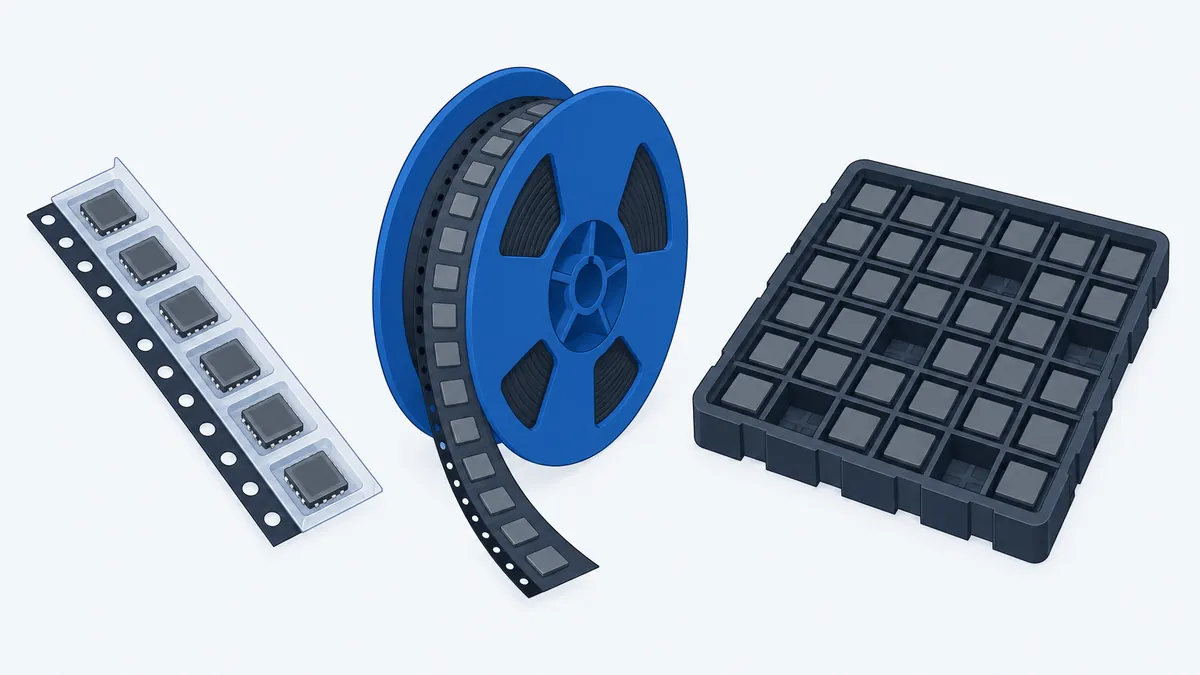
| Format | What you receive | When it fits | Confirm before ordering |
|---|
| Cut tape | One or more strips cut from a reel | Small quantities; hand placement, or assemblers that accept strips | Number of strips, continuity, minimum length your assembler accepts, labels |
| Factory full reel | The manufacturer's standard reel quantity for the orderable part number | Steady consumption on automated lines | Standard pack quantity, reel and tape size, dry-pack status |
| Custom reel | A supplier-built reel at your quantity, with leader and trailer | Quantities below a full reel that must feed automatically | Lot source, splices, leader and trailer, preparation fee |
| Tray | Devices in pockets matched to the package outline, usually sealed as a multi-tray pack | Devices supplied in trays; lines with tray handling | Tray drawing, heat rating, whether the supplier splits tray packs, whether box shipment is possible |
Choose Packaging for the Purchasing Stage
Decide by assembly method, demand stability, and the plan for any remainder. The four stages below organize those questions. They are not quantity thresholds, and trays are not the last step on a path that starts with cut tape.
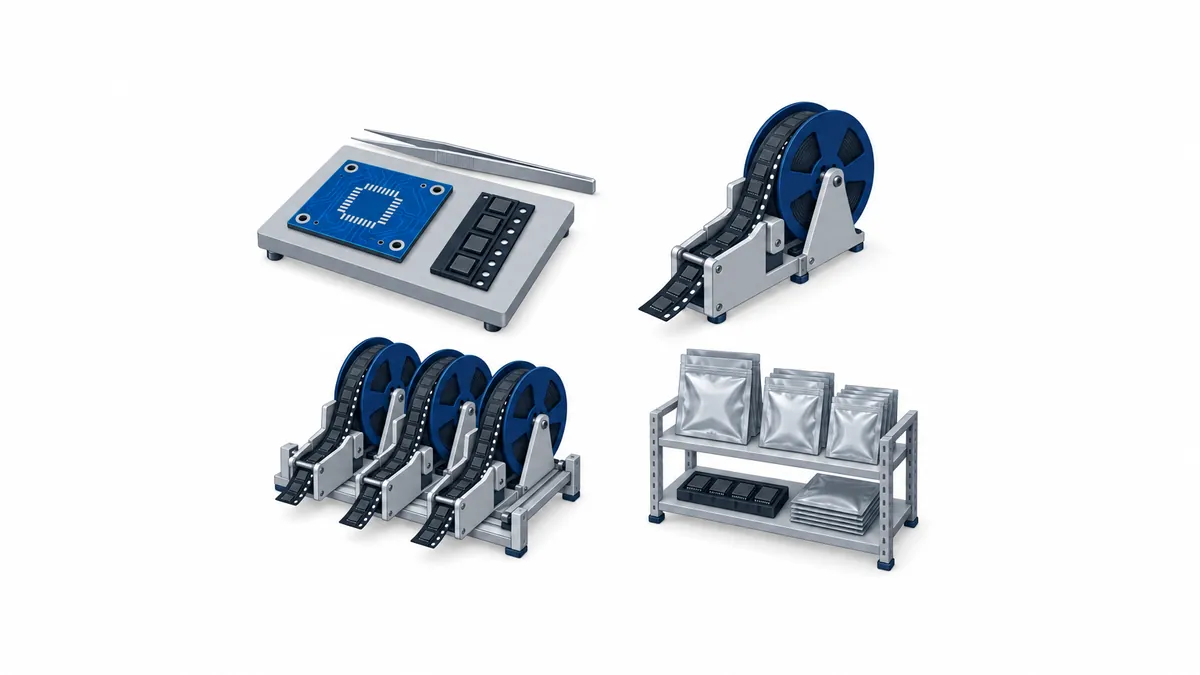
| Stage | Primary goal | Formats to evaluate first | What changes the choice | Information to confirm |
|---|
| Prototyping | Build with the correct part, without excess | Cut tape; custom reel if machine-placed | Assembler requires reels or a minimum length; device offered only in trays | Accepted carriers; build quantity plus attrition; supplier minimum order |
| Pilot build | Prove the production assembly route | Custom reel or full reel; tray for tray-supplied devices | Pilot runs on production feeders; quantity close to the standard pack | Feeder setup, continuity, who prepares leaders or splices |
| Repeat production | Match supply to consumption | Factory full reel; tray for tray-supplied devices | Demand falls; floor-life limits after the bag is opened | Standard pack quantity, reorder cadence, surplus use |
| Maintenance and spares | Keep usable, identifiable stock | Labeled cut tape, small reels, or a split tray pack | Spares feed an automated line; long storage of moisture-sensitive parts | Exact orderable part number, label retention, dry packing, opened-pack history |
Prototyping: buy for the actual build
Start from the build quantity: boards multiplied by placements per board, plus the attrition allowance your assembler specifies. If the parts are hand-placed, cut tape is usually sufficient. If a machine places them, the assembler's rules decide. Some assemblers accept strips for automated assembly above a minimum length (LionCircuits, for example, requires at least 10 cm); others want a reel with a leader. A custom reel can bridge the gap when the quantity is small but the parts must feed automatically.
Tray-only devices are where small orders get difficult, because of the tray-pack issue above. NTCHIP does not set a minimum order quantity, so we can open a tray pack to fill a small order. We dry the parts remaining in the pack in a dry cabinet and store them vacuum-sealed. Whoever you buy from, ask when an opened pack was opened and how the parts were dried and resealed, and have your quality team confirm that they can still be used within the device's floor life.
Pilot builds: confirm the assembly route
Pilot builds often run on the line setup intended for production, so the carrier question becomes concrete. Before ordering, ask your EMS whether it will load cut-tape strips onto feeders, needs a reel with a leader and trailer, or handles trays through a tray feeder or by hand. Agree on who prepares the material: the supplier, as a custom reel that usually carries a fee, or the EMS, through splicing or setup work that is usually charged as well. State whether multiple strips are acceptable.
Repeat production: align supply with consumption
When consumption is predictable, factory full reels simplify kitting and remove preparation charges. Standard pack quantities vary widely, though: in ADI's packaging table, a SOT-23-3 is listed at 10,000 parts per 13-inch reel and a 35 × 35 mm BGA at 300. One full reel may cover years of demand for one part and a single build for another. Compare the standard pack quantity with the forecast. For moisture-sensitive parts, also consider how many can be used within the floor life once the bag is opened.
Maintenance and spares: preserve usable, identifiable stock
For spares, the priorities are the exact orderable part number, labels that stay with the parts, and the protection the device needs in storage. Spares are usually needed in small quantities and often placed by hand during repair, so labeled cut tape or a split tray pack can be enough. Buy a full reel or a full tray pack only when the usage plan and storage controls justify it; an opened pack left on a shelf is exactly the moisture and oxidation risk described above.
Need only a few parts from a tray pack?
NTCHIP has no minimum order quantity. Parts left in an opened pack are dried in a dry cabinet and vacuum-sealed.
Confirm the Carrier Can Be Used on the Assembly Line
Ask the assembler to confirm the carrier data against what will actually ship before you accept a quote. "Tape and reel" on a purchase order does not, by itself, define a delivery the line can feed.
A practical confirmation sequence:
Full orderable part number, including the packaging suffix.
The manufacturer's packaging data for that number.
The carriers your assembler accepts for this build.
The delivery form the supplier will actually ship.
Any differences, and who is responsible for preparation, written into the quote.
For tape: continuity, dimensions, and orientation
Check tape width, pocket pitch, reel diameter, and pin-1 orientation against the feeder setup. Manufacturer packaging tables give these values per package, including a pin-1 orientation code defined relative to the direction of feed. Because the values change from package to package, check the row for your part rather than a typical figure. Then confirm the continuity terms: whether a leader and trailer are required, whether splices are allowed and where, and the minimum continuous length. Cut tape is not automatically a hand-placement format. Whether a strip can be fed depends on the assembler's equipment and rules.
For trays: outline, pockets, and loading method
Request the tray drawing for the actual orderable part rather than relying on a photo. The pocket must match the package outline. Confirm how the assembler loads trays (tray feeder, tray handler, or manual placement) and whether the stack suits that method. Also confirm that trays will ship as trays: TI notes that it may ship tube or tray devices in a box, depending on inventory availability.
Compare Total Order Cost, Not Unit Price Alone
Compare what each option costs for the same demand and assembly conditions, including preparation charges and a realistic value for any surplus. In a cut tape vs. full reel comparison, the reel's lower unit price is a saving only if the extra parts have a use.
Separate component spend from preparation charges
Keep three quantities apart: what the BOM requires for this build, the attrition allowance your assembler specifies, and the quantity each format or supplier requires you to buy. For tray-only devices, that last figure can be a full tray pack if the supplier does not split packs. Then list preparation charges line by line: reeling fees for custom reels, EMS setup or splicing, freight, and dry-pack handling. Check that the same work is not paid for twice, such as a supplier reeling fee plus an EMS splicing charge for the same parts.
| Item | Cut tape quote | Custom reel quote | Factory full reel quote | Tray quote (if offered) | Input source |
|---|
| Purchase quantity |
|
|
|
| Supplier quote |
| Minimum order or full-pack requirement |
|
|
|
| Supplier quote |
| Component amount (same currency and tax basis) |
|
|
|
| Supplier quote |
| Reeling or preparation charge |
|
|
|
| Supplier quote |
| EMS setup or splicing charge |
|
|
|
| EMS quote |
| Freight and handling |
|
|
|
| Supplier quote |
| Quantity consumed by this build |
|
|
|
| BOM and attrition |
| Surplus quantity and planned use |
|
|
|
| Forecast |
Fill the table with actual quotes for the same orderable part, not market averages.
Value surplus only when it has a realistic use
Surplus from a full reel or tray pack is cash spent now. Count it as an offset only when a named build, a reliable forecast, or another product will consume it within its storage limits. Moisture-sensitive parts in an opened bag have a limited floor life, which can reduce what remains usable later. Without a use plan, surplus is a cost, not a saving.
Keep Traceability and Moisture Controls Intact
At receipt, match the parts to their labels and handling records, and check ESD and moisture protection against the device's own requirements. Send any gaps to quality before the parts are released to assembly.

Keep labels connected to the supplied parts
Manufacturer labels carry the identifiers you will need later, typically the product name, lot number, quantity, and date code on the reel and its shipping box (TI's nFBGA packing method is one example). When parts are cut, split, or re-reeled, they leave that label behind unless the supplier carries the data forward. Ask for the manufacturer, full orderable part number, quantity, lot and date code, a supplier label that links to the original manufacturer label, and a record of any repacking. Labels support verification; on their own they do not prove authenticity or a complete chain of custody. For how NTCHIP approaches incoming checks, see our quality process.
Check dry packing and exposure records
Some of our customers ask to see photos of the parts before ordering, mainly to check leads or solder balls for visible oxidation. A photo is useful for that, but it cannot show moisture absorbed into the package. That is what the dry pack and its records are for.
ESD protection and moisture protection are separate controls. Tape and reel materials are typically static-dissipative, but a reel in a bag is not necessarily dry-packed: ADI, for example, ships dry-packed reels in moisture barrier bags and non-dry-packed reels in conductive ESD bags or ESD-coated boxes, to be opened only at ESD-controlled workstations.
For moisture-sensitive devices, check the dry pack itself. It usually contains desiccant, a humidity indicator card, and a moisture sensitivity caution label sealed inside a moisture barrier bag (Espressif's module dry-pack requirement shows a typical set). Confirm that the bag is intact, read the indicator card against the device's instructions, and ask when the bag was opened or resealed.
Dry-cabinet drying and vacuum sealing limit further moisture and oxidation exposure for opened stock, and that is how NTCHIP handles the remainder of opened tray packs. Whether that treatment resets a part's floor-life clock or only stops it depends on the storage conditions and how long the parts were exposed; the device instructions and IPC/JEDEC J-STD-033 govern that. Ask any supplier, including us, how opened stock was dried and stored.
Use the specified handling and baking process
Carrier heat limits and device bake requirements are separate questions. Tape, reels, and non-heatproof trays have temperature limits: Renesas, for example, marks heatproof trays with a maximum temperature, prohibits heating non-heatproof trays, and states that its tape and reels should not be baked, while Espressif requires modules to be removed from the tape before baking. This guide gives no general bake recipe; the manufacturer's delivery specification and your assembler's or quality team's procedure decide.
| Check | Records to request from the supplier | Action if there is a discrepancy |
|---|
| Part number and quantity | Packing list; label with full orderable part number and quantity | Hold; confirm with the supplier before kitting |
| Label linkage | Original manufacturer label or image; lot and date code; repack record | Quarantine; escalate to quality |
| Packaging integrity | Condition of bag, reel, or tray at shipment | Document; assess ESD and moisture exposure |
| Moisture records (where applicable) | MSL, bag seal date, humidity indicator card, open, drying, and reseal history | Follow device instructions; quality decides disposition |
| Release to assembly | Assembler's carrier acceptance; quality sign-off | Release only when the items above are closed |
Write the Required Delivery Format into the RFQ
State the acceptable carrier, continuity, and documentation requirements in the RFQ, and ask the supplier to confirm each one before you place the order.
Specify carrier acceptance and documentation
In the RFQs we receive, the carrier field is usually blank, which leaves the choice to the supplier. A cut-tape order may then arrive as several strips, a tray device may arrive in a box, and a small tray order may come from an opened pack. If any of that matters to your build, write it down. These fields make supplier replies comparable:
Manufacturer:
Full orderable part number:
Quantity (state whether attrition is included):
Build stage: prototype / pilot / repeat production / maintenance
Assembly method: manual / automated (feeder or tray handling, if known)
Required carrier: cut tape / custom reel / factory full reel / tray
Continuity and splice restrictions: single strip / multiple strips acceptable / splices allowed / single lot only
Parts from an opened pack: acceptable / acceptable with drying and reseal record / not acceptable
Lot and label requirements: manufacturer label retained / lot and date code / repack record
Moisture-handling documentation: dry pack / MSL label / humidity indicator card / open and reseal history
Requested delivery date:
Send your RFQ with the carrier spelled out
Include the fields above. We'll review the part number, quantity, carrier, and documentation requirements and reply with what we can confirm for that part. There is no minimum order quantity.
Packaging formats, pricing, and lead time are subject to confirmation at the time of quotation.
Frequently Asked Questions
Is a custom reel the same as a factory full reel?
No. A factory full reel is the manufacturer's standard pack for an orderable part number. A custom reel is a supplier service that builds a reel to your quantity from cut tape and adds a leader and trailer. Practices vary by supplier, so ask about lot source, splices, and labeling.
Can cut tape be used for automated assembly?
Often, depending on the assembler. Some accept strips above a minimum length, such as the 10 cm that LionCircuits specifies; others require a reel or a leader. Confirm with your EMS before you order.
Can I order a small quantity of a part that ships in trays?
It depends on the supplier. Tray parts are sealed in packs of several trays, and some distributors sell only full packs. NTCHIP has no minimum order quantity; when we split a pack, the remaining parts are dried in a dry cabinet and stored vacuum-sealed. Before you accept parts from an opened pack, ask how they were dried and stored.
Can components be baked in their shipping carrier?
Not by default. Check the requirements for both the device and the carrier: tape, reels, and non-heatproof trays have temperature limits, and some manufacturers require parts to be removed from the tape first. Your assembler or quality team should set the process from the manufacturer's instructions.
Sources