Three deliveries arrive at receiving inspection. One bag has been cut open. One has a new heat seal and a fresh label. One looks intact, but nobody can say where the parts were stored last month. All three raise the same question: can these parts go to reflow? This guide covers moisture-sensitive components handling at receipt, before reflow. The reason the history matters is physical. Moisture absorbed by a plastic package can vaporize during reflow and build enough internal pressure to cause delamination or cracking, which Texas Instruments calls the popcorn effect (TI AN-2029). That is a risk mechanism. It does not mean a given lot is damaged.
Can this delivery be released to production?
Receiving a delivery and releasing it to production are two decisions. Log the parts in, then release them only when the exact part, its lot, and its handling history are known well enough to apply the right moisture requirements. Until then, keep them on controlled hold.
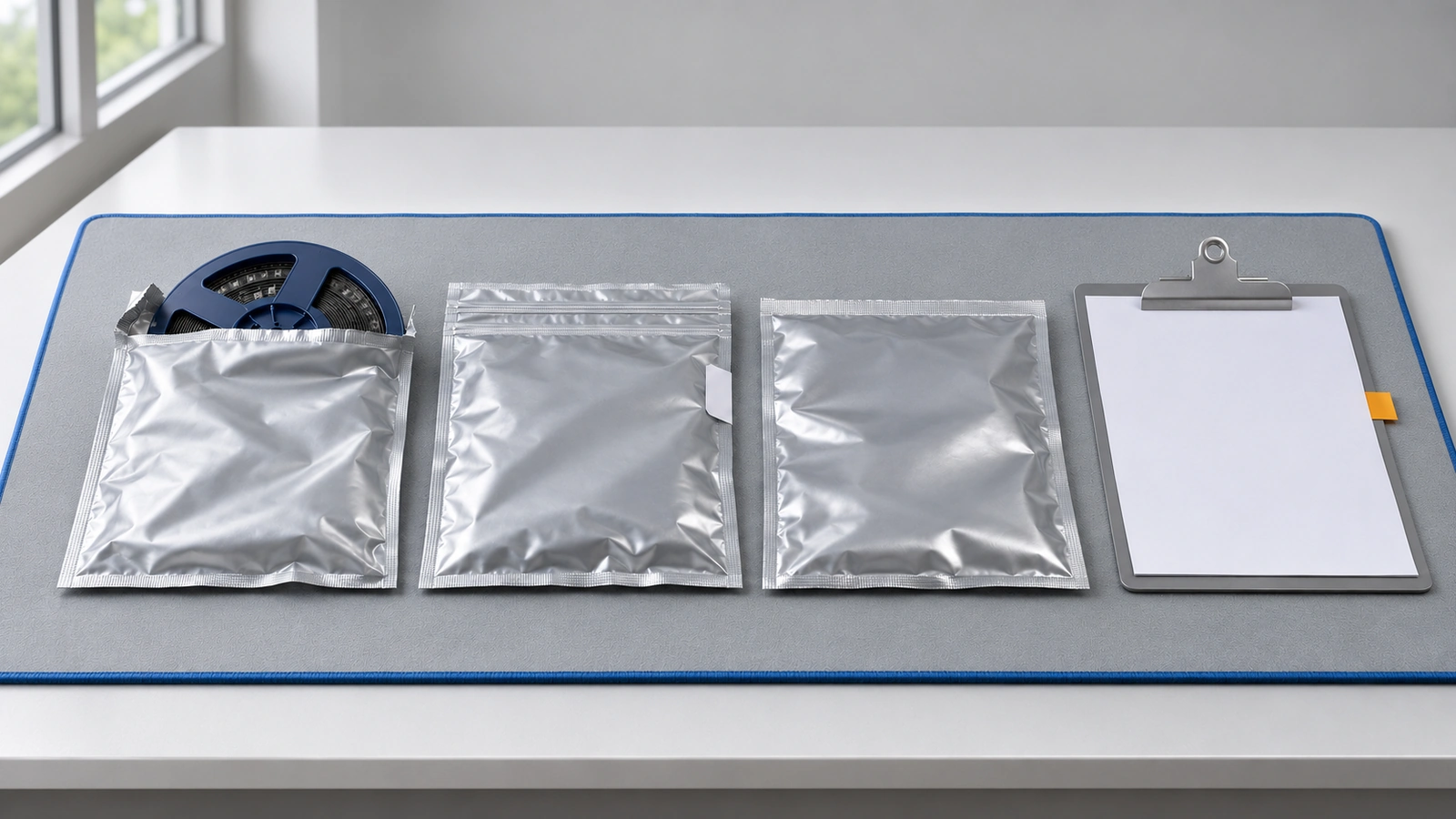
Choose a provisional receiving status
Two conditions trigger drying before reflow in TI's procedure: floor life has been exceeded, or the humidity indicator card (HIC) shows too much moisture. Both depend on information you may not have yet. The HIC is read against the instructions printed on the card and the supplier's procedure, because the spot that matters varies by moisture sensitivity level (MSL) and by vendor.
Check the order terms separately. If the purchase order required factory-sealed packs, a resealed bag is a nonconformance to discuss with the supplier, however good the resealing records are.
| Arrival condition | Evidence on hand | Suggested receiving status | To resolve before release |
|---|
| Opened bag | Label; HIC; maybe an opening date | Received, on controlled hold | Exposure periods since opening; storage conditions |
| Resealed bag | New seal and label; HIC | Received, on controlled hold | What happened before the reseal; whether drying was done |
| Records missing | Parts and outer packing only | Received, on controlled hold | Exact part, lot, and handling history |
| Known overrun | Records show floor life exceeded, or HIC indicates excess moisture | Received, not releasable as is | Drying per the applicable procedure, approved by quality |
These statuses are a practical suggestion. Your quality system decides the names and who signs the release.
A hold should not add exposure of its own. Keep held parts physically separated and in dry storage while the questions are answered. TI's guidance for parts removed from their bag is to solder them within the floor life or move them to a dry cabinet held below 25 °C and 10% RH. Otherwise the review can use up the floor life it is trying to establish.
What do the bag, label and HIC actually tell you?
Each item answers a different question. Read them one at a time, then tie them to the same part number and lot.
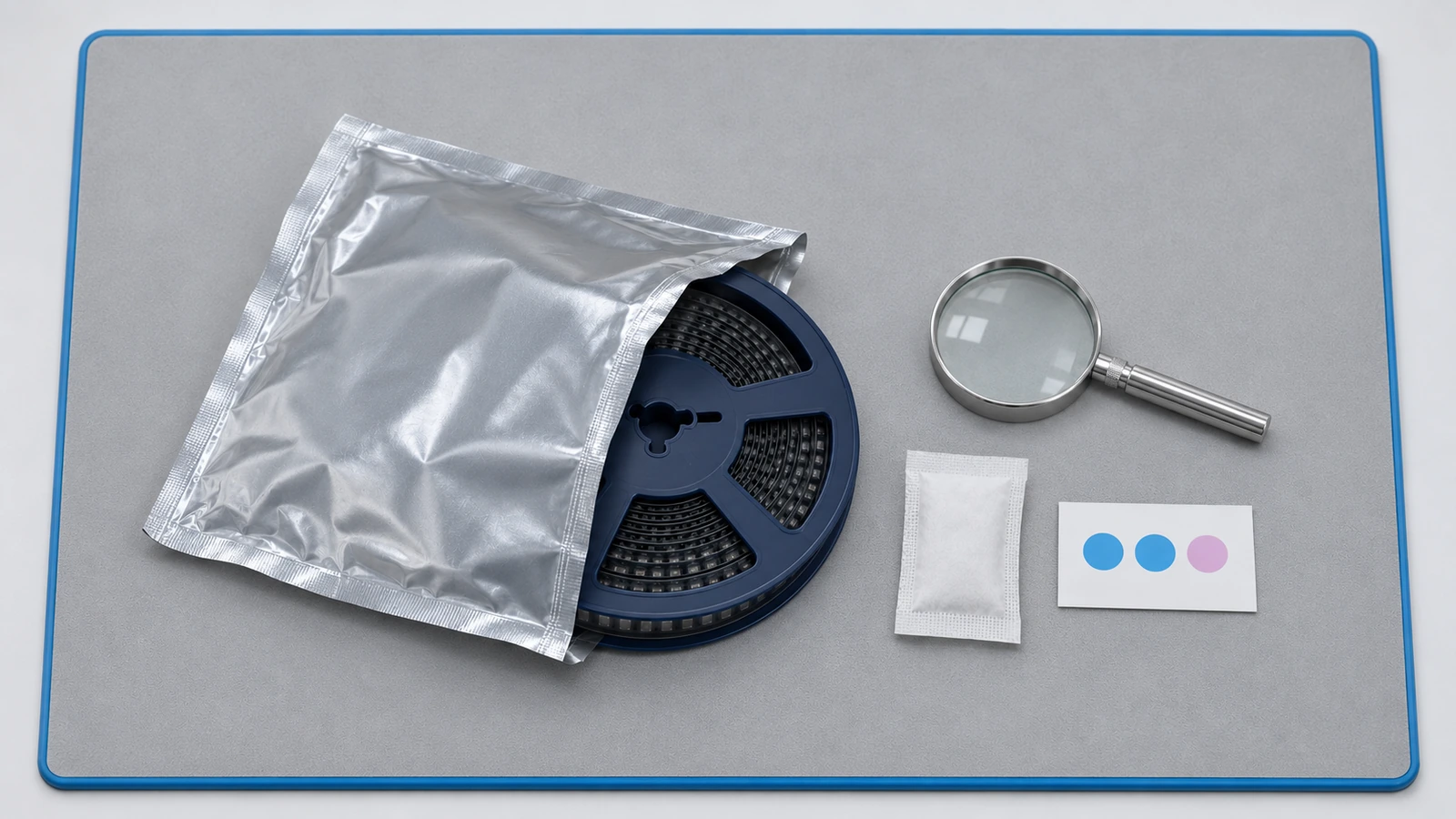
Check the bag and the exact-part label
Start with the bag. Renesas warns in its handling guide that a punctured or damaged moisture barrier bag cannot provide its intended protection, and that a drop of only a few centimeters onto a hard surface can puncture one. Look for cuts, pinholes, and creased corners as well as the seal.
Then read the label. A typical moisture-sensitive label gives the bag seal date, the MSL, and the floor life (onsemi AND8003/D). Confirm that it matches the full orderable part number and the lot on the packing list. A correct label on the wrong lot answers nothing.
Some of our customers ask to see product photos before they order, mainly to check leads or terminals for visible oxidation. A photo is useful for that, but it cannot show moisture absorbed into a package. That is what the bag, the HIC, and the records are for.
Read the HIC alongside the handling history
The HIC shows the humidity inside the bag, using color spots. It does not record when the bag was opened, how long the parts sat outside it, or what happened before a reseal. Thresholds also differ by source: TI's procedure ties the spot to read to the MSL, while Renesas uses a 30% spot in its own guide. Follow the card and the supplier's instructions rather than a single color rule.
| Evidence | What it can support | What it does not answer |
|---|
| Intact bag and seal | The barrier has not been visibly breached | Whether the parts were ever outside a bag |
| Label | Part number, MSL, floor life, seal date | Whether the seal date is the factory seal or a reseal |
| HIC | Humidity inside the bag now | Exposure time, opening date, earlier history |
| Handling records | When the parts were exposed or stored dry | Nothing, if they are not tied to this lot |
How do you assess components that arrive in an opened bag?
Rebuild the parts' history from the first opening to today, and count only the time the records can account for.
Reconstruct the exposure periods
Floor life is the time from opening the moisture barrier bag to the final reflow (TI AN-2029, Section 3). TI lists it per MSL at no more than 30 °C and 60% RH; for MSL 3, for example, the table gives 168 hours. The clock starts when the bag is first opened, not when the parts reach your dock.
List every event: the original opening, any splitting into smaller quantities, storage, resealing, shipping, and receipt. For each period, record whether the parts were exposed to ambient air or held in controlled dry storage, and what evidence shows it.
| Event | Start and end | Exposed or controlled storage (conditions) | Supporting record | Unexplained gap |
|---|
| Original bag opened |
|
|
|
|
| Parts split or counted |
|
|
|
|
| Storage |
|
|
|
|
| Resealed |
|
|
|
|
| Shipped and received |
|
|
|
|
Use only the time the records can support
Dry storage can pause the clock, but only under conditions. onsemi states that for MSL 2, 2a, and 3 parts not yet past their floor life, dry packing or a dry cabinet at 10% RH or less pauses the floor-life clock, provided the cumulative exposure stays within its limits. Paused time is not erased time.
Treat any period without a record as exposed time. Do not restart the count on the day of receipt.
Confirm the exact part's requirements: MSL, floor life, and the supplier's procedure.
Link each record to this part number and lot.
Mark every gap as unexplained.
Submit the timeline for quality or engineering review.
Does resealing restore the original floor life?
No. A new seal on its own restores nothing. What it means depends on what was done before the bag was closed and what records show it.
Separate resealing, pausing and qualified drying
Three different actions are often reported as "resealed":
Resealing. Closing parts in a moisture barrier bag with desiccant resets the bag's shelf life, according to onsemi. It does not reset floor life.
Pausing. Dry packing or a qualifying dry cabinet can stop the floor-life clock under the conditions above. The time already used still counts.
Qualified drying. Floor life can be reset by drying. onsemi describes resetting by baking, and also by room-temperature desiccation for previously dry parts that were exposed only briefly, at no more than 30 °C and 60% RH, and then held in dry storage for a multiple of the exposure time. The allowed exposure, storage humidity, and multiple depend on the MSL.
So dry storage does not always merely pause the clock, and a reseal does not always reset it. The conditions decide.
NTCHIP handles opened packs this way: parts left over after a pack is split are dried in a dry cabinet and stored vacuum-sealed. Whether that treatment pauses or resets floor life depends on the cabinet humidity, the MSL, and how long the parts were exposed first. Ask any supplier, including us, for those details.
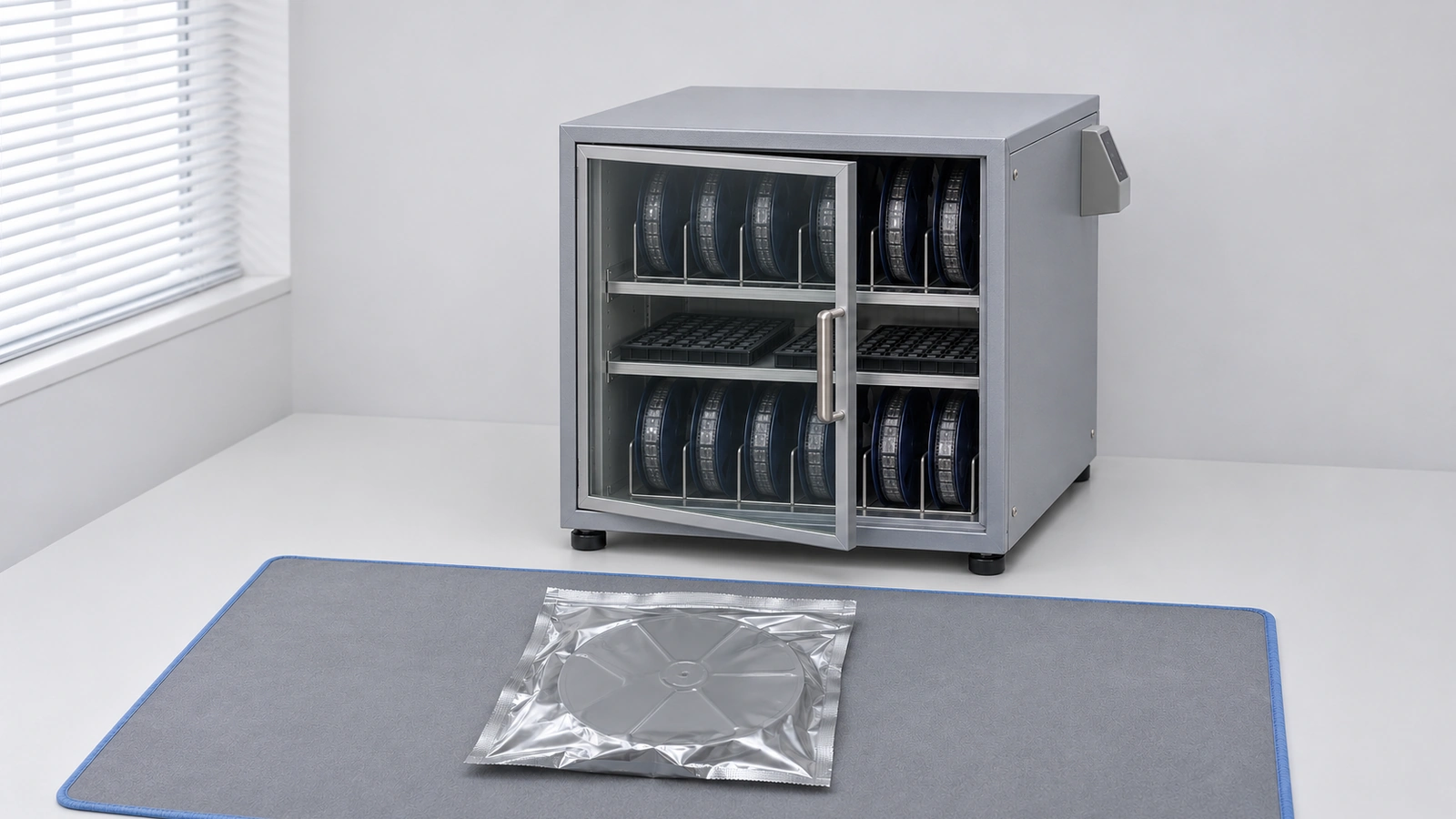
Find out what the new seal date means
A seal date on a resealed bag is the date of the reseal, not of manufacture or of the first bag. TI states that for material it repacks, the seal date indicates the date of repacking (TI quality FAQs). That statement covers TI's own process; for other suppliers, ask.
| Claimed action | Conditions or records needed | What you cannot assume at receipt |
|---|
| Resealed with desiccant | Seal date; prior exposure history | That floor life was restored |
| Stored in a dry cabinet | Cabinet humidity records; time in and out | That earlier exposure no longer counts |
| Dried at room temperature | Prior state, exposure time, storage humidity, duration | That the conditions for the MSL were met |
| Baked | Procedure used, temperature, duration, carrier | That the procedure matched the part |
Ordering a few moisture-sensitive parts?
NTCHIP has no minimum order quantity. Tell us which handling records you need, and we'll confirm what we can provide with the quote.
What if the handling history is missing?
Keep the parts on hold, request specific evidence, and set a date to decide.
Hold the release while records are recovered
Missing records do not prove the parts are damaged. They mean the inputs needed to apply the supplier's procedure are unknown. onsemi's pause and reset routes both depend on the parts' prior state and exposure, so without that history neither route can be applied. List what is missing and ask the supplier for it.
Prioritize by MSL. Floor life gets shorter as the level rises, so the same unexplained week matters far more for a high-MSL part than for a low one. A favorable HIC reading does not close the gap either: it describes the bag now, not the days before the current seal. Set a review date when you open the hold, so parts do not sit unresolved while production plans around them.
| Missing information | Evidence to request | Owner | Decision or next review |
|---|
| Original opening date | Opening record, photo of the original label | Purchasing |
|
| Storage conditions | Dry cabinet or storage humidity records | Supplier quality |
|
| Reseal details | Reseal date, desiccant, HIC at reseal | Supplier quality |
|
| Drying performed | Procedure, temperature, duration, carrier | Quality engineering |
|
Escalate the unresolved conditions
If the evidence cannot be recovered, quality or engineering decides the disposition from the part, the application, and your own procedures. That decision may be drying, return, or another route. It should not follow automatically from the missing records alone. Record who approved the release and on what evidence.
What must be confirmed before drying or baking?
Confirm the exact part, its exposure, and its carrier, and get the procedure approved before any heat is applied.
Match the procedure to the part and exposure
Drying conditions depend on package thickness, MSL, and baking temperature (TI AN-2029, Section 7). Renesas says to follow the product delivery specifications first and its general rules only when those are absent. This guide gives no universal temperature, duration, or number of bakes.
Check the carrier before applying heat
Also count the thermal history the parts still have to go through. onsemi limits each component to three reflow passes and states that floor life is not reset by reflow or rework, so a part destined for rework or double-sided assembly has less margin. Record any drying you perform so the next person to handle the parts can see it.
Carriers have their own limits. Renesas states that non-heatproof trays must not be heated and that its tape and reel should not be baked; heatproof trays carry a maximum-temperature marking. TI notes that standard tape, reel, and tube carriers should not be baked above 40 °C. Parts may need to move to a heat-resistant carrier first, which adds handling.
| Required input | Why it affects the decision | Evidence to keep |
|---|
| Full part number and package | Sets MSL and thickness | Datasheet and label |
| Exposure history | Decides whether drying is needed | Timeline and records |
| Supplier procedure | Takes priority over general rules | Document and revision |
| Carrier type and rating | May not tolerate heat | Carrier marking or drawing |
| Approval | Confirms the procedure fits | Approver and date |
Which records should travel with the shipment?
Agree on the record set before the parts ship, and write it into the RFQ.
Agree on the record set before shipment
Most moisture-sensitive components handling problems at receipt start before shipment. Packaging events only help if they are tied to the right lot. The set worth agreeing on includes the exact part number and lot, photos of the bag and label, the opening and exposure events, the basis for any controlled storage, any drying performed, and reseal records. Records exist only for handling that actually happened; a supplier should not create paperwork for steps it did not take. For the wider receiving process, see our incoming inspection checklist, and for linking parts to their lot, our guide to date codes and lot codes.
Include the requirements in the RFQ
State the requirement up front, so supplier replies can be compared.
Package state: factory-sealed only, or resealed packs acceptable with records
Records: opening date, storage conditions, drying performed, reseal date
Photos: bag, label, and HIC at shipment
Lot linkage: part number and lot on every record
Keep supplier documents with your receiving record; our comparison of CoC, CoA, test reports, and traceability records explains what each one covers.
Put your packaging and record requirements in the RFQ
Send the full part number, quantity, and the package state and records you need. We'll reply with what we can confirm for that part. There is no minimum order quantity.
Availability, pricing, and lead time are subject to confirmation at the time of quotation.
Sources