Introduction
Power electronics form the bedrock of modern industrial systems, enabling the efficient control and conversion of electrical energy. At their core are power semiconductor modules, which are essential for managing high currents and voltages in a wide range of applications. Semikron, now Semikron-Danfoss, is a renowned manufacturer in this field, known for its robust and reliable power modules. Among its widely adopted products are the SEMIPACK series, which includes the SKKT323-16E and SKKH323-16E. Despite their seemingly similar model names, these two modules serve distinct purposes due to fundamental differences in their internal configurations. This guide will delve into the specific characteristics of the SKKT323-16E and provide a detailed comparison with the SKKH323-16E, highlighting their unique features and optimal applications.
I. SKKT323-16E: A Detailed Breakdown
A. Core Specifications Overview
The SKKT323-16E is a dual thyristor, or more specifically, a Silicon Controlled Rectifier (SCR) module, engineered for high-power applications. It comes in the industry-standard SEMIPACK 3 package, which facilitates easy integration into existing designs.
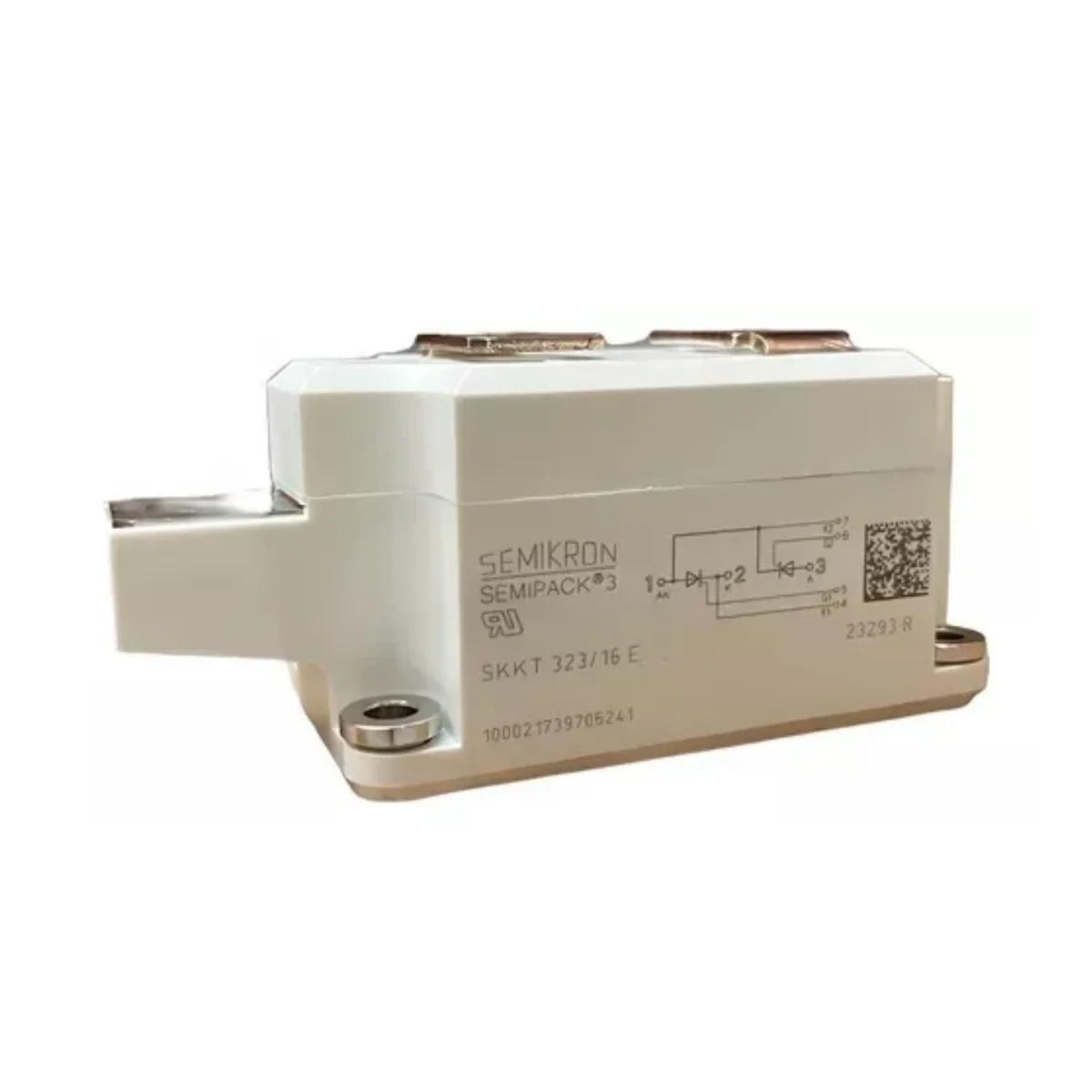
This module boasts impressive voltage and current ratings. Its repetitive peak forward blocking voltage and repetitive peak reverse voltage are both 1600V. The rated average on-state current is 320A. For robustness, the SKKT323-16E can handle a significant surge current of up to 8200A (at Tj = 25°C for 10 milliseconds). It's worth noting that while some distributor listings may show 370A, the manufacturer data of 8200A is more reliable and consistent with the expected performance of such a high-current module.
The SKKT323-16E operates over a wide temperature range, from a minimum of -40°C to a maximum of +130°C, ensuring stable operation in various industrial environments. The module dimensions are 115x50x52 mm (LxWxH), conforming to the standard SEMIPACK 3 size, and it features 7 pins for connectivity.
In terms of gate trigger characteristics, the SKKT323-16E has a typical gate trigger voltage (VGT) of 2V and a gate trigger current (IGT) of 150mA at Tj = 25°C, ensuring reliable switching operation. The maximum holding current (IH) is 150mA, with a typical range of 150-500mA.
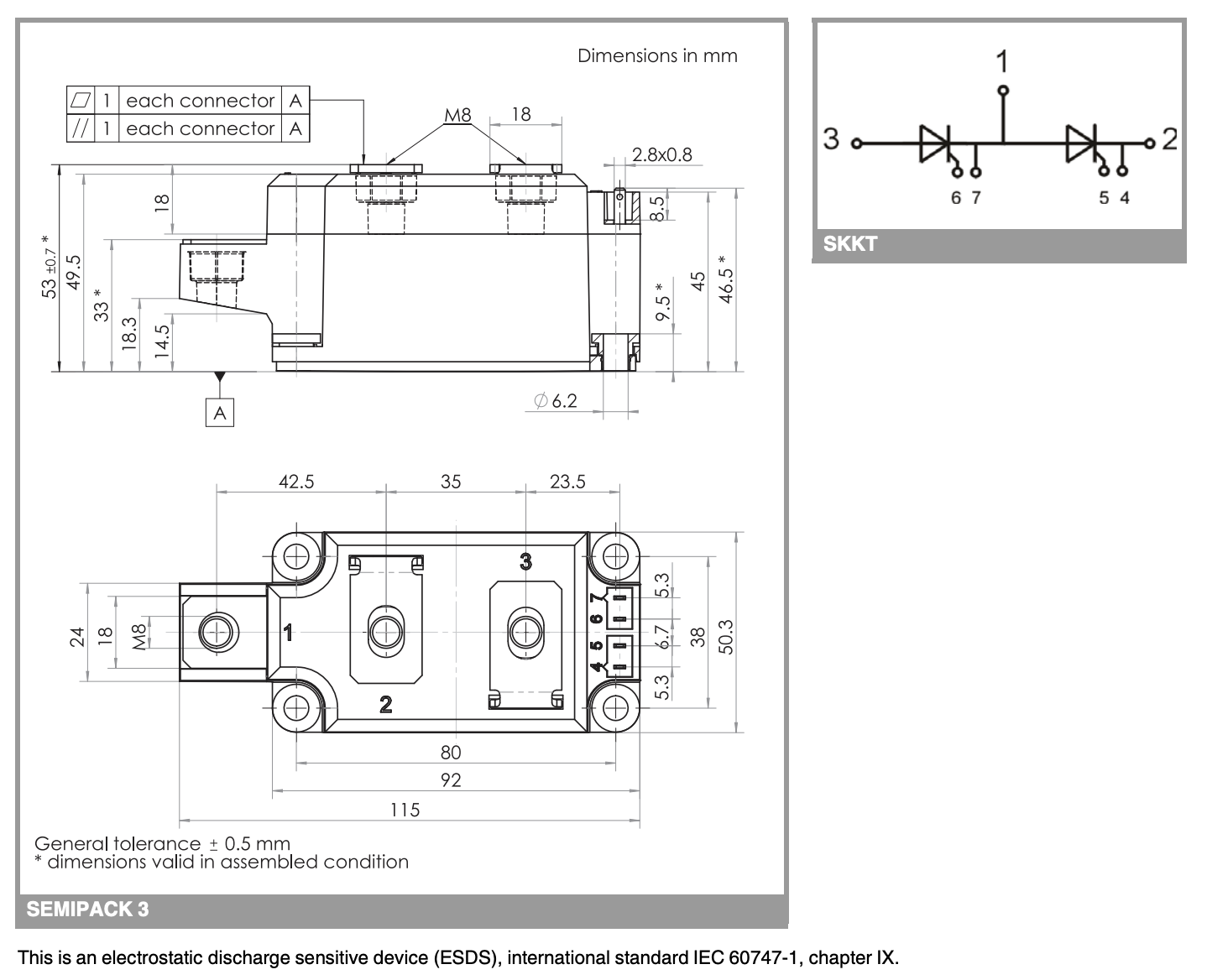
SKKT 323/16E DImension(Data Source: SKKT 323/16E Datasheet)
The table below summarizes the key technical specifications of the SKKT323-16E:
| Feature | Value |
|---|
| Average On-State Current | 320 A |
| Voltage (Repetitive Peak) | 1600 V |
| Surge Current | 8200 A (Tj=25°C, 10ms) |
| Dimensions (LxWxH) | 115x50x52 mm |
| Package Type | SEMIPACK 3 |
| Product Status | In Production |
| Technology | Thyristor |
| Topology | Rectifier (Dual Thyristor) |
| Min. Operating Temperature | -40 °C |
| Max. Operating Temperature | +130 °C |
| Number of Pins | 7 |
| Repetitive Peak On-State Voltage | 1.9 V |
| Max. Holding Current | 150 mA (typical), 150-500 mA (range) |
| Max. Gate Trigger Current | 100 mA, 150mA |
| Max. Gate Trigger Voltage | 2 V |
| UL Certified File Number | E63532 |
B. Key Features and Structure
The design of the SKKT323-16E incorporates several key features to ensure its performance and reliability in demanding industrial settings. First, it uses the industry-standard SEMIPACK 3 form factor, which guarantees compatibility and ease of integration into existing industrial designs.
Second, the module is equipped with an electrically insulated baseplate, a critical feature for both safety and performance. This baseplate provides electrical isolation between the power semiconductor and the heatsink, simplifying the thermal interface design and enhancing overall safety.
For thermal management, the SKKT323-16E achieves efficient heat transfer via an aluminum oxide ceramic (Al2O3) insulated metal baseplate. The semiconductor chips are directly soldered to a Direct Copper Bonded (DCB) Al2O3 ceramic substrate, which significantly improves thermal conductivity and enhances mechanical stability.
Furthermore, the module is UL certified (File Number E63532), confirming its compliance with safety standards for global industrial applications. Its design also includes a thyristor with a center gate, a structure that typically improves switching performance and reduces on-state losses.
C. Typical Applications
The SKKT323-16E is widely used in applications that require controlled AC power or DC power rectified from an AC source. Its typical applications include:
DC Motor Control: Particularly suitable for machine tools, where precise speed and torque control are crucial.
Temperature Control: Used in systems like ovens and chemical processes for precise regulation of heating elements.
Professional Lighting Dimming: Employed in studios and theaters for smooth and accurate control of light intensity.
D. Internal Circuit Topology
The SKKT323-16E is a "dual thyristor" or "thyristor-thyristor" module. This means it contains two SCRs, typically connected in an anti-parallel or common-anode/common-cathode configuration to enable full-wave control of an AC power source.
In terms of configuration details, the main power terminals are typically labeled 1, 2, and 3 (common anode-cathode, cathode, anode). The control terminals are labeled K1, G1, K2, G2, indicating that the two thyristors have independent gate control. This setup is crucial for enabling full-wave phase control in AC circuits.
This dual-thyristor configuration is optimized for applications requiring full-wave phase control, such as AC motor speed control or symmetrical heating elements. This is because the module, with its two controllable switches, is capable of controlling both the positive and negative half-cycles of the AC waveform. For example, in AC motor speed control, precise power delivery across both AC cycles is essential for smooth operation and efficiency. Similarly, symmetrical heating elements benefit from full-wave control to prevent DC offset and ensure uniform heating. This specific internal topology makes the SKKT323-16E the preferred choice when symmetrical, full-wave AC power regulation is needed, distinguishing it from modules used for simple rectification.
II. SKKH323-16E: The Thyristor/Diode Counterpart
A. Core Specifications Overview
The SKKH323-16E is a thyristor/diode module, also referred to as a dual thyristor-diode SCR module. Similar to the SKKT, it is also housed in the robust SEMIPACK 3 package.
This module shares the same high voltage rating of 1600V (repetitive peak forward blocking and reverse voltage) as the SKKT, and its average on-state current is also 320A. In terms of surge current capability, the SKKH323-16E exhibits a slightly higher surge current rating, reaching 9500A (at Tj = 25°C for 10 milliseconds), which is higher than the SKKT's 8200A. This suggests a potentially stronger resistance to transient overloads.
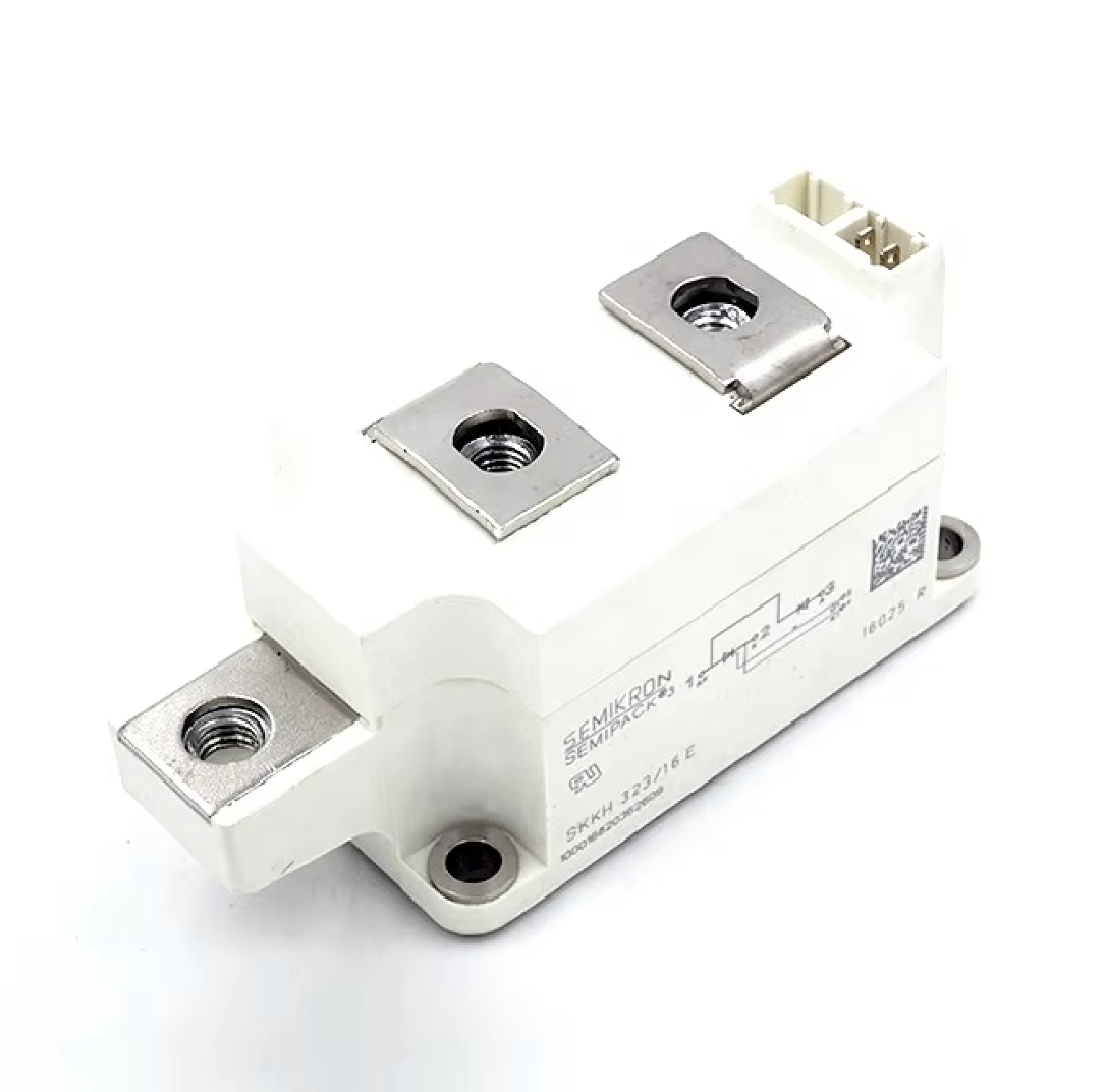
The operating temperature range for the SKKH323-16E is identical to the SKKT, spanning from -40°C to +130°C. Its dimensions are also the same as the SKKT, measuring 115x50x52 mm (LxWxH). Although not explicitly stated in all snippets, the similar package and control terminals suggest the same pin count of 7.
Regarding gate trigger characteristics, the SKKH323-16E has a typical gate trigger voltage (VGT) of 2V and a typical gate trigger current (IGT) of 150mA. The holding current (IH) is 150-500mA, and the latching current (IL) is 300-2000mA.
B. Key Features and Structure
The SKKH323-16E shares many of the robust physical features of the SKKT, including the industrial-standard SEMIPACK 3 package, an electrically insulated baseplate for safety and simplified thermal management, and thermal transfer via an aluminum oxide ceramic insulated metal baseplate with chips directly soldered onto a DCB Al2O3 ceramic. It is also UL certified (File Number E63532).
A notable distinguishing feature of the SKKH323-16E is its "amplifying gate thyristor" technology. This design reduces the gate trigger power requirement, enabling more reliable and efficient switching even with low-power control signals.
The "amplifying gate thyristor" feature in the SKKH323-16E indicates higher gate sensitivity and potentially lower gate trigger power requirements. This is a significant advantage in control circuits, especially where drive power is limited or where faster, more reliable triggering is needed, particularly in high-power applications like UPS systems or inverters. In power electronics, the gate driver circuit for a thyristor needs to provide sufficient current and voltage to reliably turn on the device. For high-power thyristors, this can sometimes require a substantial amount of gate power. The amplifying gate design includes an internal pre-amplification stage, meaning a smaller external gate signal can effectively trigger the main thyristor. The lower gate trigger power requirement translates to a simpler, more cost-effective, and potentially more efficient gate driver circuit. The enhanced sensitivity can also lead to faster and more consistent turn-on times, which is critical for precise control in dynamic systems. In demanding applications like UPS systems, inverters, or motor drives, fast and reliable switching is essential for maintaining output quality and efficiency. Achieving this with lower control power simplifies the overall system design and enhances its robustness. This feature makes the SKKH a more advanced or easier-to-use option for designers seeking to optimize their control circuitry, especially in high-power density or sensitive control environments.
C. Typical Applications
The SKKH323-16E is highly versatile and optimized for a variety of power control applications, particularly those involving rectification and phase control. Its typical applications include:
High-Power Rectifiers: Its thyristor/diode configuration makes it well-suited for converting AC power to controlled DC in industrial power supplies and rectifiers.
Soft Starters: Used for smoothly starting motors, reducing inrush current and mechanical stress on the motor.
Inverters and UPS Systems: Serves as a key component in the power conversion stages of uninterruptible power supplies and inverters.
Motor Drives: Similar to the SKKT, it's used in DC motor control for machine tools and industrial drives, and in AC motor soft starters.
Welding Equipment: Its robust design and surge current capability make it suitable for high-current applications like welding.
Temperature Control: Also applicable in ovens and chemical heating systems.
Professional Lighting Dimming: Can be used in studio and theater lighting systems.
D. Internal Circuit Topology
The SKKH323-16E is a "thyristor/diode" module. This means it contains one thyristor and one fast recovery diode, connected in a series arrangement within the module.
For configuration details, terminal 3 is typically connected to the anode of the diode, and terminal 2 to the cathode of the thyristor, forming the module's primary current path. Terminal 1 serves as the common connection node between the diode cathode and the thyristor anode. The control terminals are labeled 4 (K1) and 5 (G1), corresponding to the gate and cathode control pins for the single thyristor. This setup is specifically designed for efficient operation in phase control and rectification circuits, typically enabling half-wave control.
The "thyristor/diode" configuration is inherently suited for rectification and half-wave phase control applications. The integrated diode provides a path for current to flow in one direction, while the thyristor controls the other, making it an ideal choice for converting AC to controlled DC or in applications where only half a cycle needs to be actively controlled. The diode only allows current to flow in one direction. The thyristor also only allows current to flow in one direction after it is triggered. When they are combined in a series, they create a device capable of rectifying an AC signal (due to the diode) and controlling the conduction angle of a half-cycle (due to the thyristor). This is the basis of half-wave controlled rectification. Unlike the dual-thyristor SKKT, which can control both the positive and negative half-cycles of an AC current, the SKKH, with its integrated diode, is primarily designed for scenarios where one direction of current is always permitted (by the diode) and the other is actively controlled (by the thyristor). Applications like high-power rectifiers, soft starters, and UPS systems often involve converting AC to controlled DC. The SKKH's topology is a perfect fit for these requirements, providing a compact and efficient solution for these power conversion stages. This fundamental difference in internal structure dictates its primary use cases. While both modules handle high power, the SKKH is tailored for rectification and unidirectional controlled power flow, distinguishing it from the SKKT's full-wave AC control capability.
III. SKKT323-16E vs. SKKH323-16E: A Comparative Analysis
While both are part of Semikron's SEMIPACKR 3 series and their model names differ by only one letter, they have fundamental differences in internal structure, function, and applications.
| Feature | SKKT323-16E | SKKH323-16E |
|---|
| Internal Structure | Thyristor / Diode | Thyristor / Thyristor |
| Functionality | Half-Controlled Rectifier | Fully Controlled Rectifier or AC Switch |
| Typical Applications | - Half-controlled bridge rectifiers
- DC motor speed control
- Soft starters | - Fully controlled bridge rectifiers
- AC motor speed control
- AC power control (e.g., electric heaters) |
| Surge Current | I_TSM (25°C): 9500A | I_TSM (25°C): 9500A |
| Average Current | I_T(AV) (85°C): 320A | I_T(AV) (84°C): 323A |
A. The Fundamental Difference: Internal Circuitry
The most critical distinction between the SKKT323-16E and SKKH323-16E lies in their internal semiconductor arrangement.
SKKT323-16E (Thyristor/Diode): This configuration means it can only perform half-wave or half-controlled rectification. Current can only flow in one direction, but the output power can be controlled via the thyristor's trigger angle.
SKKH323-16E (Thyristor/Thyristor): This is a dual thyristor module. The two thyristors are connected in an anti-parallel configuration, forming a complete bidirectional control unit. It can be used as a fully controlled rectifier or as a switch in AC circuits, controlling current bidirectionally, which is essential in applications like AC motor speed control.
B. Shared Characteristics
Despite their key differences, the SKKT323-16E and SKKH323-16E share several important characteristics:
Manufacturer: Both modules are produced by Semikron (now Semikron-Danfoss), a reputable name in power electronics, ensuring product quality and reliability.
Voltage Rating: Both are rated for a repetitive peak voltage of 1600V.
Average On-State Current: Both modules can handle an average on-state current of 320A.
Package Type: Both use the standardized SEMIPACK 3 housing, which facilitates mechanical integration and thermal management.
Dimensions: They have the same overall dimensions, 115x50x52 mm (LxWxH).
Operating Temperature Range: Both operate within a junction temperature range of -40°C to +130°C.
Core Structural Features: Both modules benefit from an electrically insulated baseplate, thermal transfer via Al_2O_3 ceramic, chips soldered onto a DCB Al_2O_3 ceramic, and UL certification.
Gate Trigger Parameters: Both have a typical gate trigger voltage (VGT) of 2V and a gate trigger current (IGT) of 150mA.
C. Differentiating Characteristics
In addition to the fundamental difference in internal topology, there are a few other distinguishing characteristics:
Surge Current Capability: The SKKH323-16E typically exhibits a slightly higher surge current rating (9500A) compared to the SKKT323-16E's 8200A.
Amplifying Gate Technology: The SKKH323-16E incorporates an "amplifying gate thyristor," which reduces the gate trigger power requirement and enhances trigger reliability. This feature is not explicitly mentioned for the SKKT323-16E in the provided snippets, suggesting it's a specific enhancement for the SKKH series.
Latching Current (I_L): The SKKH datasheet explicitly lists a latching current (I_L) of 300-2000mA, while this parameter is not detailed for the SKKT in the provided snippets. Latching current is the minimum anode current required to keep the thyristor in the on-state after the gate signal is removed.
The SKKH323-16E's slightly higher surge current capability (9500A for the SKKH323-16E vs. 8200A for the SKKT323-16E based on manufacturer data) suggests that the SKKH module may have greater robustness against transient overcurrent events, potentially making it more suitable for applications with frequent or severe inrush currents, such as motor soft starters or UPS systems. Surge current (I_TSM) is the maximum non-repetitive peak on-state current that a thyristor can withstand for a short duration (e.g., 10 milliseconds) without damage. A higher I_TSM value indicates a greater resistance to instantaneous overloads, like those encountered during motor startups, capacitor charging, or fault conditions. The 1300A difference (9500A vs. 8200A) represents a significant increase in the SKKH module's transient handling capability. Applications like motor soft starters are specifically designed to manage the high inrush currents during motor acceleration. UPS systems must handle sudden load changes and potential fault currents. A module with a higher surge current capability provides a larger safety margin and can potentially improve reliability in these demanding environments. While both modules are robust, this subtle difference in surge current suggests that the SKKH may be the slightly superior choice for applications where transient overcurrents are a primary design consideration, offering an added layer of protection and longevity.
D. Application Suitability and Selection Guide
When to choose the SKKT323-16E:
Ideal for full-wave phase control of an AC source, requiring symmetrical control of both positive and negative half-cycles.
Suitable for AC motor speed control (e.g., via a controlled rectifier bridge), symmetrical heating applications, and professional lighting dimming that requires operation on the full AC waveform.
Its dual thyristor configuration makes it a direct fit for applications that require two controllable switches.
When to choose the SKKH323-16E:
Primarily designed for controlled rectification (AC-to-DC conversion), specifically half-wave controlled rectification, where the diode provides an uncontrolled path for one half-cycle and the thyristor controls the other.
Excellent for high-power rectifiers, soft starters, inverters, and UPS systems, where its integrated diode and amplifying gate technology offer specific advantages.
Its slightly higher surge current capability may be more beneficial in applications prone to significant inrush currents.
The table below provides a direct comparison of the SKKT323-16E and SKKH323-16E:
| Feature | SKKT323-16E | SKKH323-16E | Key Differences/Notes |
|---|
| Module Type (Topology) | Dual Thyristor (Thyristor-Thyristor) | Thyristor / Diode | Different internal circuit configurations |
| Average On-State Current | 320 A | 320 A | Same |
| Repetitive Peak Voltage | 1600 V | 1600 V | Same |
| Surge Current (10ms, Tj=25°C) | 8200 A | 9500 A | SKKH is slightly higher |
| Package Type | SEMIPACK 3 | SEMIPACK 3 | Same |
| Dimensions (LxWxH) | 115x50x52 mm | 115x50x52 mm | Same |
| Min. Operating Temp. | -40 °C | -40 °C | Same |
| Max. Operating Temp. | +130 °C | +130 °C | Same |
| Gate Trigger Voltage (VGT) | 2 V (typ.) | 2 V (typ.) | Same |
| Gate Trigger Current (IGT) | 150 mA (typ.) | 150 mA (typ.) | Same |
| Holding Current (I_H) | 150-500 mA (typ./max) | 150-500 mA (typ./max) | Same |
| Latching Current (I_L) | Not explicitly provided | 300-2000 mA (typ./max) | Explicitly listed for SKKH |
| Key Features | Center Gate Thyristor | Amplifying Gate Thyristor | SKKH has amplifying gate technology, reducing trigger power requirements |
| Typical Applications | Full-wave AC control, DC motor control, temperature control, lighting dimming | Controlled rectification, soft starters, inverters, UPS, welding equipment, temperature control, lighting dimming | SKKT focuses on full-wave AC control; SKKH focuses on controlled rectification and amplifying gate benefits |
IV. Practical Considerations for Design and Reliability
The Importance of Proper Heat Dissipation and Thermal Management
Both the SKKT323-16E and SKKH323-16E are high-power devices that generate significant heat during operation. Effective heat dissipation is crucial for their lifespan and reliable performance. Features like the module's "electrically insulated baseplate" and "thermal transfer via aluminum oxide ceramic insulated metal baseplate" are designed to facilitate heat removal. Designers must ensure that adequate heat sinks and thermal interface materials are used to keep the junction temperature within the specified operating range (-40°C to +130°C).
Worst-Case Voltage Rating Selection
Although both modules are rated for 1600V, designers must account for voltage transients, overshoots, and line voltage fluctuations that occur in real-world industrial environments. Operating the device within its maximum ratings, often by limiting the current to within 75% of the nominal rating, is a good practice to ensure long-term operation.
A Brief Look at Common Failure Modes and Preventive Measures
Thyristor failures can be categorized as gradual degradation (e.g., a change in blocking voltage) or sudden catastrophic failures (often a short circuit).
Most Common Failure Mode: The most common failure mode for thyristors is an electrical short circuit between the main terminals.
Causes: Most failures occur from exceeding maximum operating ratings, primarily overvoltage or overcurrent. Insufficient heat dissipation leading to excessive junction temperature is also a common cause. Mechanical damage from improper handling or mounting torque can also lead to potential failure.
Prevention:
Careful Device Selection: Choose the correct device for the specific application's operating parameters and environment.
Circuit Protection: Implement proper circuit protection, such as fuses and over-temperature cutouts, to protect the system and users in case of a device short circuit.
Proper Heat Dissipation: Ensure effective thermal management to prevent overheating.
Correct Voltage Rating Selection: Account for worst-case voltage conditions.
Current Derating: Limit the maximum current through the main terminals to within 75% of the device's rating.
Proper Installation: Adhere to specified mounting torque and handling procedures to avoid mechanical stress.
Conclusion
The Semikron SKKT323-16E and SKKH323-16E modules are both robust, high-performance power semiconductor devices that share core specifications like voltage, average current, and the reliable SEMIPACK 3 housing. However, their internal topologies dictate their distinct roles: the SKKT, with its dual thyristor configuration, excels at full-wave AC phase control, while the SKKH, with its thyristor/diode arrangement and amplifying gate, is optimized for controlled rectification and applications where enhanced gate sensitivity and surge capability are needed.
For power electronics engineers and designers, understanding these fundamental differences in internal circuitry is crucial. It ensures that the selected module is a perfect fit for the application's specific control requirements, preventing inefficiencies, failures, and potential safety hazards. By carefully considering the key specifications and underlying topology, designers can fully leverage the potential of these powerful Semikron modules to build reliable and efficient industrial power systems.
FAQ
1. What is the key difference between SKKT323-16E and SKKH323-16E?
The SKKT323-16E is a dual thyristor module ideal for full-wave AC control, while the SKKH323-16E is a thyristor/diode module optimized for half-controlled rectification.
2. Where do each of these Semikron modules perform best?
The SKKT323-16E excels in applications needing bidirectional power control, like AC motor speed control. The SKKH323-16E is best for rectifiers, soft starters, and UPS systems that convert AC to controlled DC.
3. What is the advantage of the "amplifying gate" technology in the SKKH323-16E?
The amplifying gate thyristor technology lowers the gate trigger power requirement, enabling simpler, more efficient control circuit design and ensuring more reliable triggering in high-power applications.
4. Which module can withstand a higher surge current?
According to the Semikron datasheets, the SKKH323-16E has a higher surge current rating (9500A), making it more robust against transient overloads than the SKKT323-16E (8200A).
5. Why is thermal management so important for these power modules?
As high-power devices, they generate significant heat. Effective heat dissipation is crucial to prevent the junction temperature from exceeding its limit, which is essential for ensuring the long-term reliability and lifespan of the power module.