Introduction
In modern industry and the field of power electronics, efficiency and reliability are the absolute top priorities. Whether it is driving industrial motors with high-performance Inverters, providing precise heat with Induction Heating equipment, or serving as the essential core of high-efficiency High Power Supplies and Welders, the central component is the Insulated Gate Bipolar Transistor (IGBT) Module.
IGBT modules combine the high-speed switching characteristics of the MOSFET with the strong current-handling capability of the bipolar transistor. This makes them the ideal choice for high-voltage, high-current switching operations. Their introduction has dramatically accelerated the development of power conversion systems toward greater efficiency, smaller size, and higher power density.
The subjects of this article are two leading products from the Mitsubishi Electric (or its partner, Powerex) NFH series: the CM600DU-24NFH and the CM300DU-24NFH. The "NFH" designation indicates that they are IGBT modules specifically optimized for high-frequency, low-loss applications, making them a premium choice for designs seeking ultimate switching performance. Both use a 1200V voltage platform, securing their role as key components in industrial applications.

II. Shared Strengths: The Excellence of the NFH Series IGBT Modules
Since the CM600DU-24NFH and CM300DU-24NFH belong to the same NFH series, they share many core structural and technological advantages from Mitsubishi or Powerex. These common features guarantee their reliability and high performance in high-power, high-frequency environments:
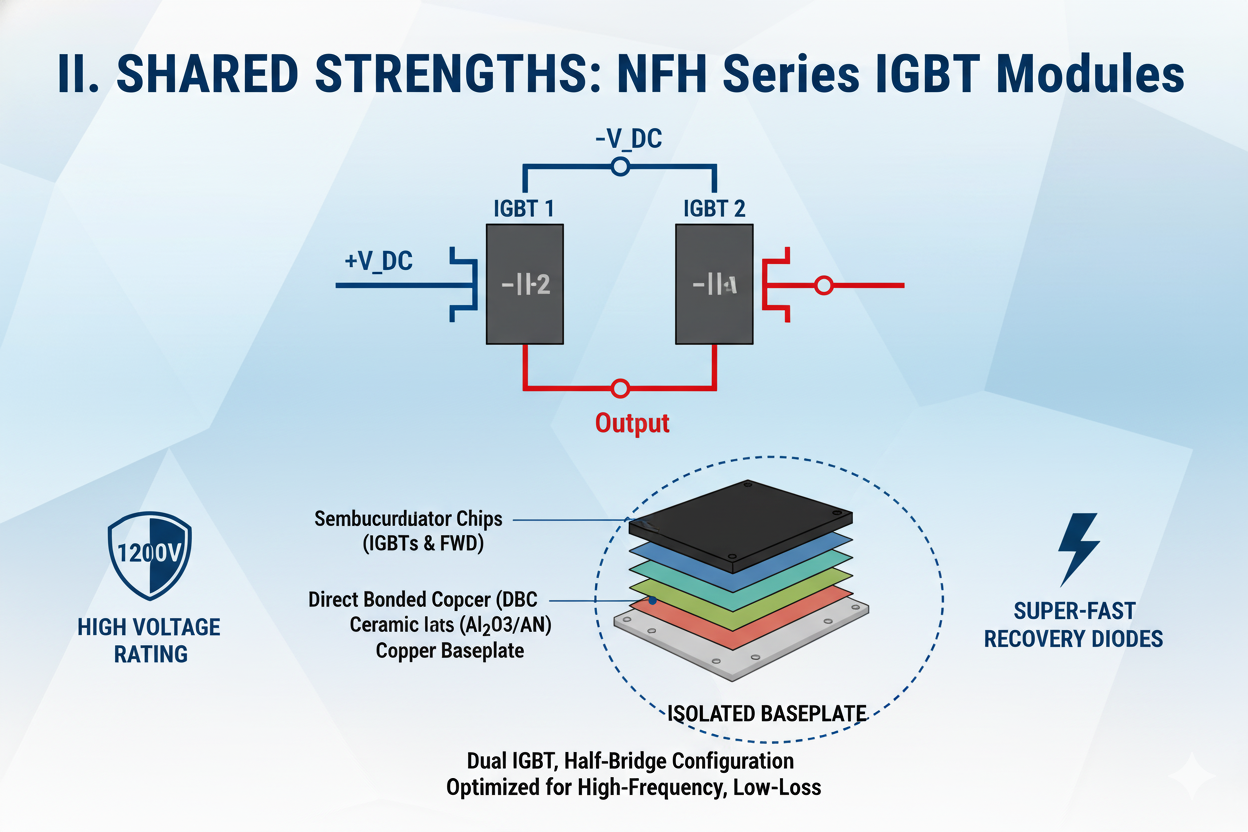
Dual IGBT and Half-Bridge Configuration
Configuration: Both modules incorporate two independent IGBT transistors connected in the classic Half-Bridge setup.
Significance: The half-bridge is the fundamental unit for building essential power conversion circuits, such as inverters, DC-DC converters, and three-phase inverters. Using a dual-module structure greatly simplifies system design, wiring, and the overall assembly process.
High Voltage Rating: 1200V
Rated Voltage: The Collector-Emitter Maximum Voltage for both modules is 1200V.
Significance: This high voltage rating makes them the ideal choice for medium-to-high voltage industrial applications, such as three-phase inverters operating on 400V or 690V AC lines. This provides an ample safety margin to withstand transient voltage spikes during switching.
Integrated Super-Fast Recovery Free-Wheel Diode
Integrated Feature: Each IGBT has a Super-Fast Recovery Free-Wheel Diode (FWDi) connected in antiparallel.
Significance: In high-frequency switching operations, the FWDi must turn on and off very quickly during current transition. The Super-Fast Recovery characteristic means minimal reverse recovery time and charge. This dramatically reduces switching losses and voltage stress, acting as the foundation for achieving highly efficient, high-frequency switching.
Optimized High-Frequency Switching Performance
Design Goal: The NFH series is specifically engineered for Low Switching Loss, especially in high-frequency environments.
Performance: They are well-suited for applications with high switching frequencies. For example, Hard Switching topologies can operate up to around 30 kilohertz, while Soft Switching topologies can even reach 60 kilohertz to 70 kilohertz. This makes them a perfect fit for fields like induction heating and resonant power supplies.
Isolated Baseplate for Simplified Thermal Management
Isolation: The module’s internal components and connections are electrically isolated from the external Baseplate.
Advantage: This design allows the module’s baseplate to be mounted directly onto a Heatsink without the need for additional insulating pads. This simplifies system assembly and ensures superior thermal performance, which is essential for high-power-density designs.
These shared technical foundations enable both modules to achieve high industrial standards for performance and reliability. However, as we have mentioned, the difference in their current ratings is the key factor that distinguishes their ultimate applications, which will be detailed in the next section.
III. Core Comparison: Key Parameter Differences
While the CM600DU-24NFH and CM300DU-24NFH share the excellent genes of the NFH series, their primary differences lie in current handling capability and corresponding thermal characteristics. Below is a comparative analysis of the key parameters for these two modules:
| Parameter Name | CM600DU-24NFH | CM300DU-24NFH | Difference Analysis (No Special Symbols) |
|---|
| Collector DC Current (Rated Current) | 600 Amperes | 300 Amperes | The most crucial distinction. The continuous current capability of the 600DU is double that of the 300DU, suiting it for much higher power output requirements. |
| Peak Collector Current (Pulse) | 1200 Amperes | 600 Amperes | The corresponding pulse current rating is also doubled, indicating that the 600DU has a greater tolerance for instantaneous current surges. |
| Maximum Power Dissipation | Approx. 3700 Watts (Baseplate Temp 25 degrees C) | Approx. 1900 Watts (Baseplate Temp 25 degrees C) | Due to the doubled current capability, the 600DU generates a higher maximum heat output under the same conditions, demanding a more robust cooling system. |
| Junction-to-Case Thermal Resistance (IGBT) | Approx. 0.081 Celsius per Watt (per half-bridge) | Approx. 0.11 Celsius per Watt (per half-bridge) | Lower thermal resistance means better heat dissipation. The 600DU has lower resistance, showing its internal chip and packaging have a more optimized heat path to conduct heat more effectively. |
| Input Capacitance | Approx. 95 Nanofarads | Approx. 47 Nanofarads | Input capacitance is proportional to the IGBT chip area. The 600DU's larger capacitance signifies a bigger internal chip area, which is why it can handle higher current. |
| Total Gate Charge | Approx. 2700 Nanocoulombs | Approx. 1360 Nanocoulombs | Gate charge is the critical factor for selecting a driver circuit. The 600DU's gate charge is nearly double the 300DU's, thus requiring a gate driver capable of supplying a higher peak current to achieve the same switching speed. |
| Outline Dimensions | Standard Package Size (Typically around 108mm x 62mm) | Standard Package Size (Typically around 108mm x 62mm) | Both modules generally use the same industry-standard package outline. This provides significant convenience for engineers designing a product family across different power levels. |
Summary of Current and Drive Differences
As the table shows, the CM600DU-24NFH significantly outperforms the CM300DU-24NFH across all current-related critical metrics.
Power Handling Capability: With its higher collector current rating, the 600DU is intended for equipment with greater power output.
Thermal Management Challenge: Although the 600DU has a lower thermal resistance design, its total power dissipation is higher. Therefore, in real-world applications, designers must configure a more powerful and efficient cooling system (such as larger heatsinks, stronger fans, or liquid cooling solutions) for the CM600DU-24NFH.
Gate Drive Design: Because the 600DU has larger input capacitance and gate charge, its driver circuit must be able to deliver a higher peak current to quickly and effectively turn the IGBT on and off. Failure to do so will result in sharply increased switching losses.
Understanding these core parameter differences allows us to make a more accurate judgment on which module to select for specific application scenarios.
IV. Application Considerations: How to Make the Right Choice
In power electronics design, selecting the correct IGBT module is critical for ensuring system performance, reliability, and cost-effectiveness. When choosing between the CM600DU-24NFH and the CM300DU-24NFH, the decision revolves primarily around power requirements, thermal management capability, and driver complexity.
1. Scenarios for Choosing the CM600DU-24NFH
When your design goal is to achieve maximum power output or handle very large currents, the CM600DU-24NFH is the more appropriate choice:
High Power Demand: It is suitable for large-scale applications requiring 600 Amp continuous current capacity, such as high-power industrial inverters, large uninterruptible power supplies (UPS), high-current industrial welders, and high-power traction systems.
Increased Design Effort: Utilizing this module demands a more robust and detailed design investment:
Thermal Management: You must engineer a more efficient, lower thermal resistance cooling system, potentially requiring high-performance forced air or liquid cooling solutions to effectively dissipate the higher maximum power output.
Gate Drive: You must select a gate drive circuit capable of delivering a higher peak current to quickly drive its larger input capacitance, ensuring switching losses are kept to a minimum.
2. Scenarios for Choosing the CM300DU-24NFH
For projects in the medium power class, the CM300DU-24NFH offers an excellent balance:
Medium Power Applications: It is suitable for equipment where a 300 Amp continuous current capacity is sufficient, such as mid-sized inverters, medium-power induction heating equipment, or standard switching power supplies.
Cost and Drive Advantages:
Cost-Effectiveness: Due to the smaller chip area, the manufacturing cost of this module is typically lower than the CM600DU-24NFH.
Simplified Drive: The lower gate charge means it requires less peak current from the gate driver, simplifying the driver circuit design and reducing its cost and complexity.
3. Interchangeability and Product Family Design
These two modules generally share the same industrial standard package outline and pin layout. This consistency offers a huge advantage for creating a product family:
"Pin-to-Pin" Replacement: If your product line includes both 300 Amp and 600 Amp power levels, you can achieve different power configurations by simply swapping the IGBT module while using the same main board layout.
Critical Limitations: Although the packages are compatible, this replacement is not without constraints. The designer must ensure that:
Cooling System: The baseplate assembly can effectively handle the higher heat generated by the higher-power (600DU) module.
Driver Circuit: The gate driver must satisfy the higher peak current needed by the larger (600DU) module.
Can the CM600DU-24NFH Replace the CM300DU-24NFH?
This is a common engineering question. The answer is: Generally, yes, but it requires necessary circuit modifications and rigorous validation.
Replacing the CM300DU-24NFH (300 Amperes) with the higher-rated CM600DU-24NFH (600 Amperes) is essentially swapping a weaker component for a stronger one. This is beneficial for the safety margin of the main circuit. However, you must focus on three key areas:
1. Physical Fit (Mechanical Compatibility)
Conclusion: Compatibility is high.
Reason: Both modules belong to the standard industrial package series. Their dimensions, mounting holes, and the positions of the main power and control pins are typically identical. You can install the 600 Amp module directly onto the existing heatsink or circuit board, just like the 300 Amp module.
2. Main Circuit Electricals
Conclusion: Fully compatible.
Reason: Both modules share a 1200 Volt rating. In a circuit originally designed for 300 Amperes, using the 600 Amp module provides double the current capacity, reducing the module's internal losses and increasing the system's reliability and safety margin.
3. Key Challenges: Drive and Thermal Management
These are the most critical—and most error-prone—aspects of the substitution.
Challenge 1: Gate Drive Circuit
The Issue: The 600 Amp module has a larger chip area inside, meaning its input capacitance and total gate charge (the electrical energy required for driving) are nearly double those of the 300 Amp module. If you continue to use the original gate driver board, the drive current may be insufficient.
Consequence: The speed of gate turn-on and turn-off will slow down, leading to significant thermal losses during the switching process, which could potentially destroy the module.
Solution: You must upgrade or modify the gate drive circuit to ensure it can supply a strong enough instantaneous current to quickly and effectively drive the 600 Amp module's gate. Furthermore, the gate resistor may need fine-tuning to optimize the switching waveform.
Challenge 2: Thermal Management System
The Issue: The 600 Amp module has a higher maximum power dissipation. Although its thermal design (thermal resistance) is better, the total heat generated under high load still exceeds that of the 300 Amp module.
Consequence: If the original heatsink or cooling system was just barely adequate for the 300 Amp requirement, replacing it with the 600 Amp module risks exceeding the junction temperature limit, negatively affecting longevity and reliability.
Solution: Even if the current demand remains the same, it is recommended to re-evaluate or test the entire cooling system to confirm that the module's internal temperature remains within the safe operating range under worst-case conditions.
The Risk of Downgrade Substitution: Can the CM300DU-24NFH Replace the CM600DU-24NFH?
In the vast majority of cases, the CM300DU-24NFH *cannot* replace the CM600DU-24NFH. This is the exact opposite of the previous scenario; it involves a downgrade substitution and carries major safety hazards and risks.
1. The Core Problem: Insufficient Current Capacity
Rated Current: The CM600DU-24NFH has a continuous current rating of 600 Amperes. The CM300DU-24NFH's continuous rating is only 300 Amperes.
Design Logic: A system originally designed for the 600 Amp module inherently requires or operates close to 600 Amperes of current handling capability (or needs sufficient margin for close to 600 Amp pulse currents).
Consequence: If you substitute the 300 Amp module, and the system operates beyond 300 Amperes, the new module will immediately experience overcurrent. This will cause the internal chip to overheat, rapidly exceed its maximum junction temperature, and ultimately lead to thermal breakdown and failure, potentially causing serious equipment damage.
2. Physical Compatibility (The Only Pro)
Conclusion: Physical size and pin layout are usually compatible (both use the same package outline).
A Word of Caution: While it may fit physically, this does not mean it will function correctly. In power electronics, physical fit is the least important factor; electrical and thermal performance are paramount.
3. Thermal Management and Reliability Risk
Risk: Even if the system current stays below 300 Amperes at certain times, the 300 Amp module will have a higher current density due to the halved capacity, generating proportionally more internal heat. The module will run at a higher operating temperature.
Consequence: Sustained high temperatures will drastically reduce the module's lifespan and reliability. Even without catastrophic failure, the equipment will fail much sooner than expected.
Conclusion and Recommendation
Do not use the CM300DU-24NFH to replace the CM600DU-24NFH.
This type of substitution violates a fundamental principle of power electronics design: the replacement component's rating must be equal to or greater than the original component's rating.
Safety Advice: If you must replace the CM600DU-24NFH, the only safe choice is another module rated at 600 Amperes or higher that is voltage- and package-compatible.
Sole Exception: The only exception is if you are absolutely certain that the original system was severely over-specified during design, and your actual maximum operating current will never exceed the 300 Amp safety margin (e.g., actual maximum current stays below 250 Amperes for margin). Only then, and after adjusting the driver circuit and completing a thermal assessment, might you consider the downgrade. However, this is extremely dangerous and not recommended in serious industrial applications.
V. Summary and Recommendations
The CM600DU-24NFH and CM300DU-24NFH are both highly reliable 1200V high-frequency dual IGBT modules. Their main difference lies in the rated collector current: one is a "heavy-duty performer" at 600 Amperes, and the other is a "high-efficiency workhorse" at 300 Amperes.
The final selection decision should always revolve around these three core factors:
Actual Power Requirement: How much continuous current does your application need? Build in a sufficient safety margin, and choose the 300 Amp or 600 Amp module accordingly.
Thermal Management Capability: Can your heatsink design effectively dissipate the extra heat generated by the 600 Amp module (approximately 3700 Watts)?
Gate Drive Strength: Can your driver circuit supply enough peak current to quickly and efficiently drive the larger gate charge of the high-current (CM600DU-24NFH) module?