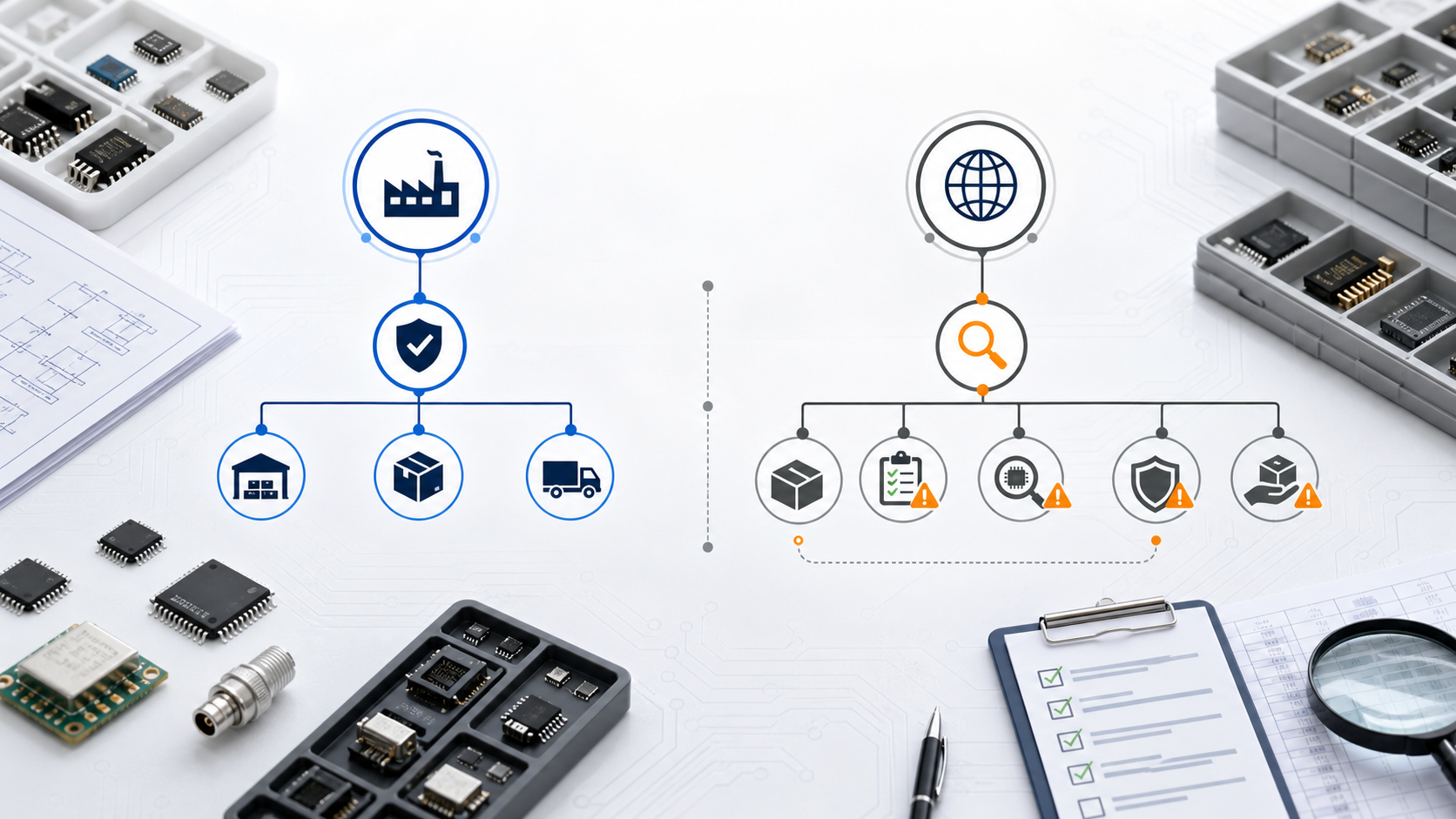
If you are sourcing parts for a new design with stable demand, an authorized distributor is often the cleaner first choice. If you are trying to locate hard-to-find components, obsolete parts, shortage-driven items, or mixed BOM lines that standard channels cannot support, an independent electronic components distributor may give your purchasing team more sourcing flexibility.
The better choice depends on the sourcing situation, not on a single label.
Authorized distributors are tied to manufacturer-approved supply channels. Independent distributors, including NTCHIP, work outside the authorized channel and focus on locating components across a broader sourcing network. That can be useful when availability is fragmented, the part is no longer active, or the buyer needs BOM-level help instead of a single catalog order.
The important point is trust. Independent sourcing can help solve real procurement problems, but it requires careful supplier evaluation, documentation review, and quality-control awareness. This guide explains how to compare both distributor types and how procurement teams can decide which route fits the risk profile of a hard-to-find component.
Quick Answer
For new designs and active parts, start with authorized distribution when availability, pricing, and schedule fit the project. For hard-to-find components, obsolete parts, shortage sourcing, repair demand, and BOM support, an independent distributor can be a practical option if the supplier has a disciplined sourcing and verification process.
Use this simple rule:
| Sourcing situation | Better starting point | Why it usually fits |
|---|
| New product design with active parts | Authorized distributor | Cleaner channel alignment and manufacturer-backed product flow |
| Standard replenishment for common parts | Authorized distributor or franchised channel | Lower sourcing complexity when stock is available |
| Hard-to-find components | Independent distributor | Broader search across non-standard supply sources |
| Obsolete or EOL parts | Independent distributor | Authorized channels may no longer carry the item |
| Shortage or allocation pressure | Independent distributor, plus risk review | May help locate alternatives or available supply when standard channels are constrained |
| Mixed BOM support | Independent distributor | One sourcing partner may help review many line items together |
| Safety-critical or highly regulated application | Authorized channel first, or strict independent review | Documentation, traceability, and approval requirements may be higher |
NTCHIP should be understood as an independent electronic components distributor, not as an authorized distributor unless a specific authorization is separately verified. Buyers should confirm availability, pricing, lead time, documentation, and quality requirements through RFQ before purchase.
What Is an Authorized Distributor?
An authorized distributor sells components through a manufacturer-approved distribution relationship. In many cases, the distributor receives products directly from the manufacturer or an approved channel, then supports customers with order processing, product information, and standard supply terms.
For procurement teams, the main advantage is channel clarity. When the part is active, available, and suitable for the project schedule, authorized distribution can reduce sourcing uncertainty.
Authorized distributors are often a strong fit when:
The design is new and the part is still active.
The buyer needs manufacturer-backed channel documentation.
The purchase requires strict approval from engineering, quality, or compliance teams.
The required quantity and schedule are supported by standard catalog availability.
The buyer wants a stable repeat-buy path for production.
There are limits, though. Authorized channels may not solve every shortage, allocation, last-time-buy, repair, or obsolete component problem. A part can be technically valid for an existing product but no longer easy to buy through standard distribution. That is where many procurement teams begin evaluating independent sourcing.
What Is an Independent Electronic Components Distributor?
An independent electronic components distributor sources parts outside manufacturer-authorized distribution agreements. Instead of relying only on one approved channel, an independent distributor works across a wider network of suppliers, excess inventory sources, distributors, and market availability.
This model can help when a buyer is not dealing with a clean catalog purchase. Common examples include obsolete ICs, shortage-driven components, discontinued modules, repair parts, and BOMs with several difficult line items.
Independent distribution is not the same as being authorized. That distinction matters. A responsible independent distributor should be clear about its role and should not imply manufacturer authorization, partnership, guaranteed stock, guaranteed lead time, or guaranteed authenticity without evidence.
The value is different. A good independent distributor helps buyers search, compare options, request documentation, check part details, and reduce sourcing risk before a purchasing decision is made.
NTCHIP's positioning fits this category: independent electronic component sourcing support for global buyers, with RFQ handling, BOM review, and quality-control awareness. For available options, buyers can browse electronic components or request a quote with the exact manufacturer part number and purchasing requirements.
Authorized Distributor vs Independent Distributor
The comparison is easiest when viewed through a procurement lens. The question is not which channel sounds safer in general. The question is which channel can support the actual part, timeline, documentation need, and application risk.
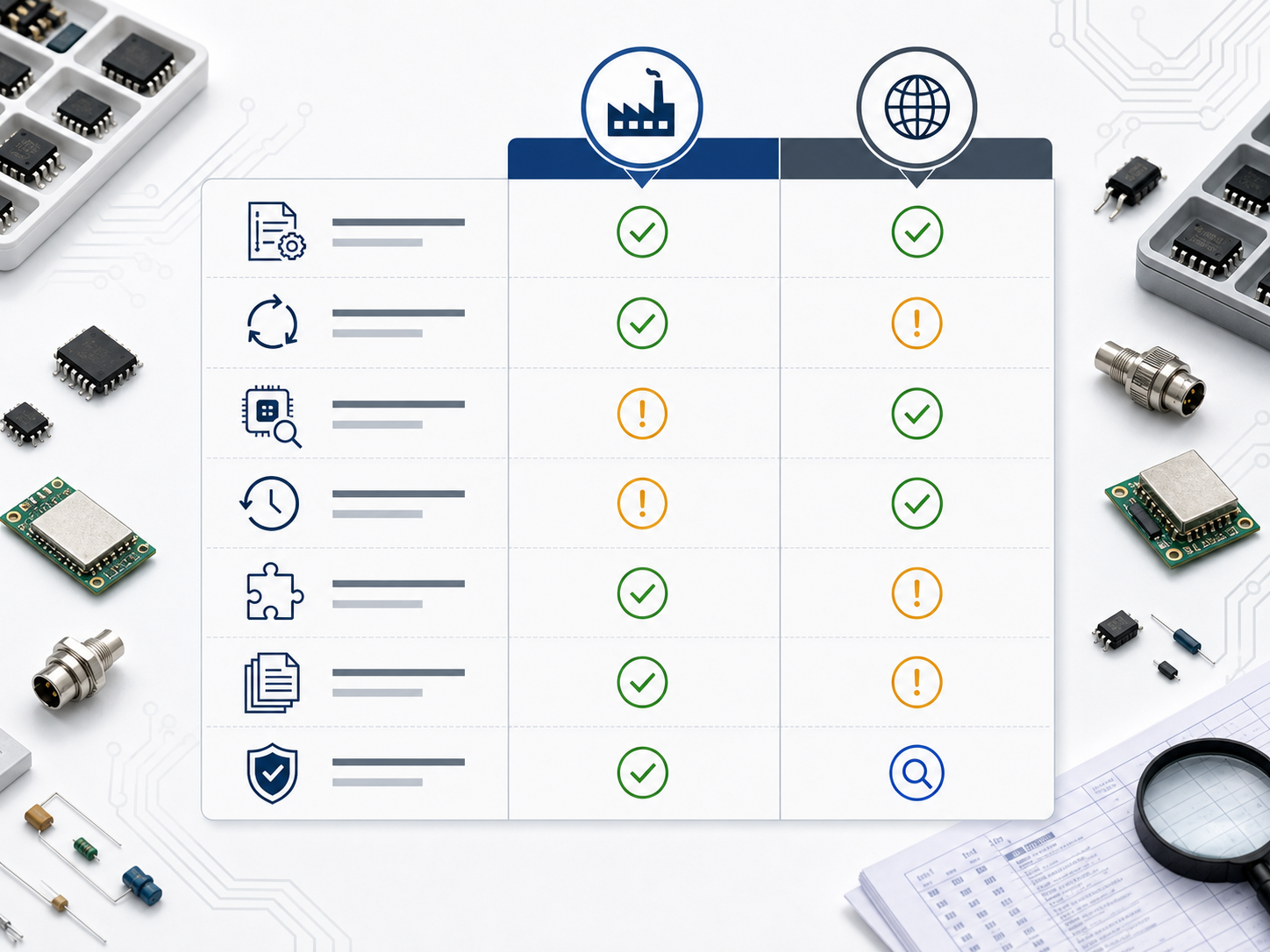
| Evaluation factor | Authorized distributor | Independent distributor |
|---|
| Channel relationship | Manufacturer-approved channel | Non-authorized sourcing network |
| Best fit | Active parts, new designs, repeat production | Hard-to-find, obsolete, shortage, and mixed BOM sourcing |
| Availability coverage | Strong when manufacturer channel has supply | Broader search when standard channels cannot support demand |
| Documentation path | Often clearer through authorized channel | Must be requested and reviewed case by case |
| Lifecycle support | Good for current parts | Useful when parts are EOL, NRND, or no longer widely available |
| Speed of search | Fast for catalog-stocked items | Useful when sourcing requires manual search and supplier checks |
| Quality-control need | Still important, but channel risk is usually lower | More important because source history can vary |
| Buyer responsibility | Confirm fit, quantity, price, and lead time | Confirm all part details, source documents, testing needs, and application risk |
For a procurement manager, this table should lead to a process decision. Use authorized channels where they meet the need. Use independent sourcing when the part cannot be solved through normal distribution, and apply a stricter review process before issuing the PO.
Which Is Better for Hard-to-Find Components?
For hard-to-find components, an independent distributor is often the more useful sourcing route because the problem is usually market coverage. The buyer is trying to locate a valid part, compare available options, and understand risk when standard channels are empty, constrained, or no longer carrying the component.
Hard-to-find sourcing often includes:
Obsolete ICs used in legacy equipment.
End-of-life components for maintenance or repair.
IGBT modules and industrial parts with limited availability.
Memory ICs, connectors, relays, crystals, and passives that are tied to an older BOM.
Allocation-sensitive parts during shortages.
Mixed BOMs where several lines require manual sourcing work.
An independent distributor can help by checking more than one supply route and by asking the buyer for the information needed to avoid mistakes. That includes the full manufacturer part number, package, quantity, target date, acceptable date-code range, quality requirements, and any required documentation.
Still, independent sourcing should not be treated as a shortcut around verification. For obsolete or shortage-driven components, buyers should review the manufacturer, full part number, package, date code, lifecycle status, datasheet, and application requirements before purchase. When substitution is being considered, engineering should compare electrical ratings, package, pinout, thermal limits, firmware or timing dependencies, and qualification requirements.
For quality-sensitive projects, procurement teams can also review NTCHIP's quality control page and include documentation expectations in the RFQ.
When an Authorized Distributor Is Usually Better
Authorized distribution is usually the better first step when the component is active, the manufacturer's channel has availability, and the project needs a low-friction purchasing path.
This is especially true for new designs. If engineering is choosing parts for a fresh PCB or product release, sourcing from an authorized channel can make lifecycle planning, repeat purchasing, and internal approval easier. It can also reduce the need to explain why the team selected a non-standard source.
Authorized distribution also fits cases where the buyer needs manufacturer-backed documentation or a purchasing policy requires approved channels. Some industries and applications have stricter traceability requirements. In those cases, the sourcing route may be determined by compliance rules before price or speed is discussed.
Use authorized distribution first when:
The part is active and available.
The product is entering production and needs repeat supply.
Manufacturer channel documentation is required.
The buyer's quality system requires approved sources.
Engineering has not yet frozen the BOM and can choose a current part.
Even then, buyers should confirm the exact part number, package, minimum order quantity, pricing, lead time, and lifecycle status before committing to a design or order.
When an Independent Distributor May Be Better
Independent distribution becomes more useful when the buyer's problem is not a normal catalog purchase. The harder the sourcing case, the more value there is in a distributor that can search broadly, compare options, and help the buyer prepare a complete RFQ.
An independent distributor may be the better route when:
The required part is obsolete, EOL, or no longer widely stocked.
Standard authorized channels show no availability or long allocation pressure.
The purchasing team is supporting repair, maintenance, or legacy production.
The buyer needs help reviewing a BOM with many component categories.
Engineering needs sourcing input before considering alternates.
The buyer needs human communication instead of only a cart checkout.
This is where NTCHIP's independent positioning is relevant. NTCHIP can support requests for ICs, IGBT modules, memory ICs, connectors, passives, relays, crystals, optoelectronics, and other component categories. The right starting point is a clear RFQ, not an assumption that every item is in stock.
To speed up review, send manufacturer, full part number, package, quantity, target date, application context where appropriate, and any documentation or quality requirements. You can contact NTCHIP or submit a sourcing request through the request a quote page.
Distributor Trust Checklist for Procurement Teams
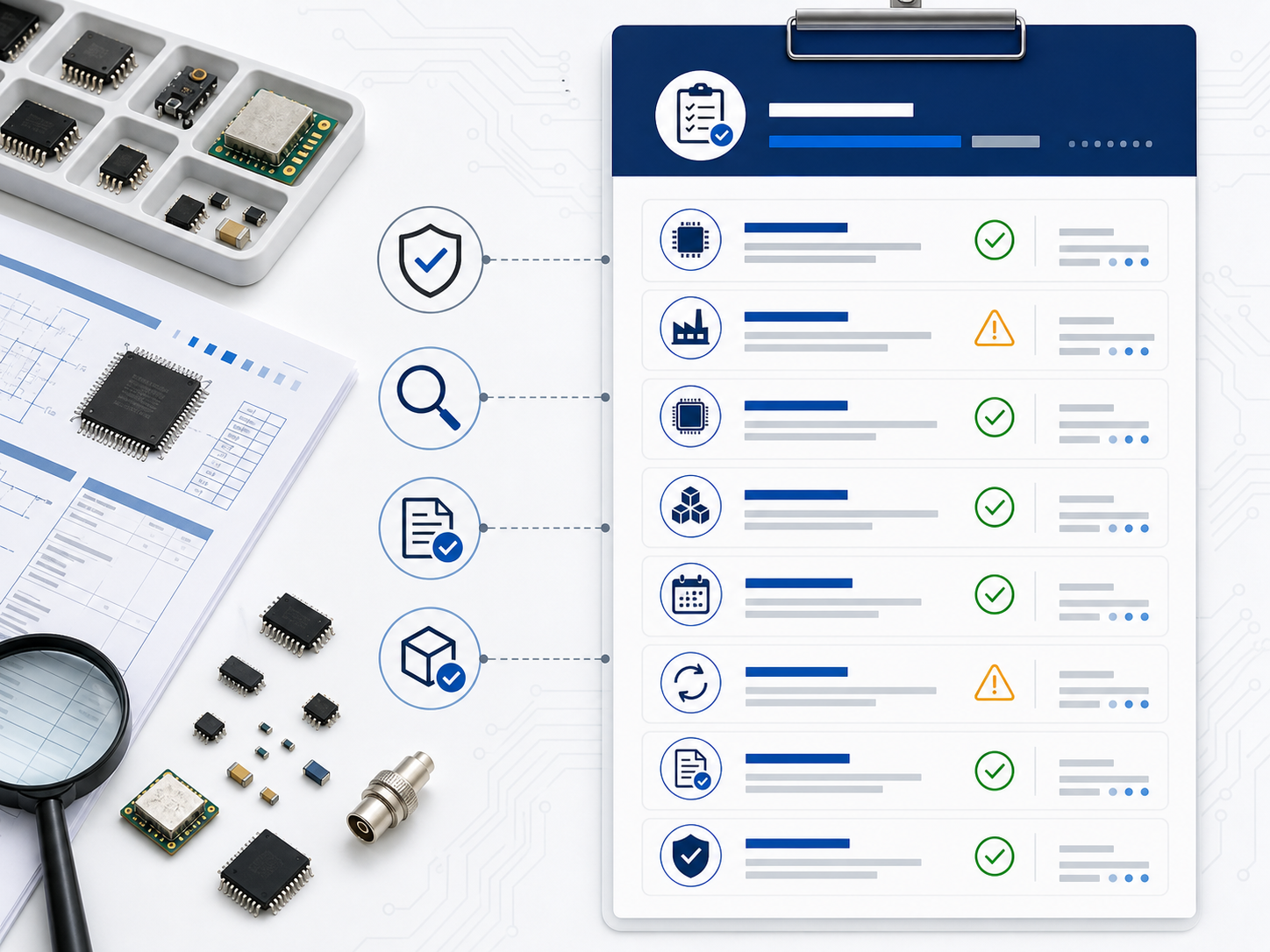
Before buying hard-to-find components from any supplier, evaluate the distributor's process. A trustworthy supplier should help reduce uncertainty, not rush the buyer past it.
Use this checklist during supplier review:
Clear role: Does the distributor state whether it is authorized, independent, or another type of supplier?
No unsupported claims: Does the supplier avoid unverified claims about authorization, guaranteed stock, guaranteed lead time, price, warranty, or certifications?
Complete RFQ intake: Does the supplier ask for manufacturer, full part number, package, quantity, target date, and quality requirements?
Documentation discussion: Can the supplier explain what documentation may be available and what must be confirmed?
Part-number discipline: Does the supplier treat suffixes, package codes, temperature grades, and date-code needs carefully?
Lifecycle awareness: Does the supplier flag obsolete, EOL, NRND, or allocation-sensitive parts for extra review?
Quality-control awareness: Does the supplier discuss inspection, handling, packaging, and documentation without promising results it cannot prove?
Alternative caution: Does the supplier avoid claiming drop-in replacement compatibility without datasheet and engineering review?
Communication quality: Are responses specific enough for procurement, engineering, and quality teams to act on?
Manual verification path: Does the buyer have a clear list of items to confirm before purchase?
For independent sourcing, this checklist matters more because the supply path can vary by part and by market condition. A buyer should feel that the distributor is helping them ask better questions, not just pushing a quick purchase.
What to Include in an RFQ for Hard-to-Find Components
A strong RFQ helps both sides. It reduces back-and-forth, prevents part-number mistakes, and gives the distributor enough context to identify sourcing risk early.
For each line item, include:
| RFQ field | Why it matters |
|---|
| Manufacturer name | Reduces confusion between equivalent-looking part numbers |
| Full part number | Captures suffix, package, grade, and reel or tray details |
| Quantity | Helps determine sourcing options and packaging expectations |
| Target date | Lets the distributor evaluate urgency without assuming lead time |
| Package or footprint | Prevents package mismatch on legacy or alternate items |
| Datasheet or reference BOM | Gives engineering context for verification |
| Date-code requirements | Important for lifecycle, storage, and quality review |
| Application or project type | Helps identify whether extra caution is needed |
| Required documentation | Keeps quality and purchasing expectations visible |
| Alternate acceptance | Clarifies whether engineering will consider substitutes |
For BOM support, send the full spreadsheet when possible. Independent distributors can often help identify which lines are standard, which are constrained, and which may need extra review. NTCHIP can use that information to support component sourcing discussions across categories instead of treating each line as an isolated request.
Useful External References for Channel and Risk Review
Procurement teams should use neutral references when building internal sourcing policies. For channel definitions and authorized distributor searches, ECIA and TrustedParts can help buyers understand manufacturer-authorized distribution structures. For counterfeit-risk process language, SAE AS6081 is widely referenced in the aerospace and defense supply chain as a standard focused on counterfeit electronic parts avoidance for distributors. CISA supply chain risk management material can also help teams think about supplier risk more broadly.
These references do not replace supplier due diligence. They give purchasing, quality, and engineering teams a shared vocabulary for source selection, traceability, documentation, and risk review.
In practice, use external references for policy language and use the RFQ process for the actual part. Availability, pricing, lead time, documents, and quality requirements should be confirmed for the specific manufacturer part number before purchase.
FAQ
Is an independent distributor the same as an authorized distributor?
No. An authorized distributor has a manufacturer-approved distribution relationship. An independent distributor sources components outside that authorized channel. Both can be useful, but buyers should understand the difference before purchasing.
Is an independent electronic components distributor safe to use?
It can be, but the buyer must evaluate the supplier's process. For hard-to-find or obsolete parts, ask about documentation, part-number verification, quality-control steps, packaging, date-code needs, and any limits on traceability. Avoid suppliers that make unsupported guarantees.
When should procurement choose an authorized distributor?
Choose authorized distribution first for active parts, new designs, standard production supply, or situations where manufacturer channel documentation is required by your quality system or customer contract.
When should procurement consider an independent distributor?
Consider an independent distributor when authorized channels cannot support the part, the component is obsolete or hard to find, the market is under shortage pressure, or the buyer needs help reviewing a mixed BOM.
Can NTCHIP help with obsolete or shortage-driven components?
NTCHIP can support RFQ review and sourcing communication for hard-to-find, obsolete, and shortage-driven electronic components. Availability, pricing, lead time, documentation, and quality requirements should be confirmed through RFQ for each specific part.
What should I send to NTCHIP for a faster RFQ?
Send the manufacturer, full part number, quantity, package, target date, acceptable alternatives if any, date-code requirements, and any documentation or quality requirements. A BOM spreadsheet is helpful when multiple lines need review.
Conclusion: Choose the Channel That Matches the Risk
Authorized distributors and independent distributors serve different procurement needs. Authorized channels are usually best for active parts, new designs, and purchases that require manufacturer-approved distribution. Independent distributors are often more useful when the buyer needs hard-to-find components, obsolete parts, shortage sourcing, or BOM support.
For procurement teams, the strongest approach is practical: start with the channel that fits the part, then apply the right level of verification. For independent sourcing, that means clear RFQs, careful part-number review, documentation requests, lifecycle checks, and quality-control discussion before purchase.
NTCHIP supports global buyers as an independent electronic components distributor for hard-to-find components and BOM sourcing needs. To begin, contact NTCHIP or request a quote with the exact part number and sourcing requirements.